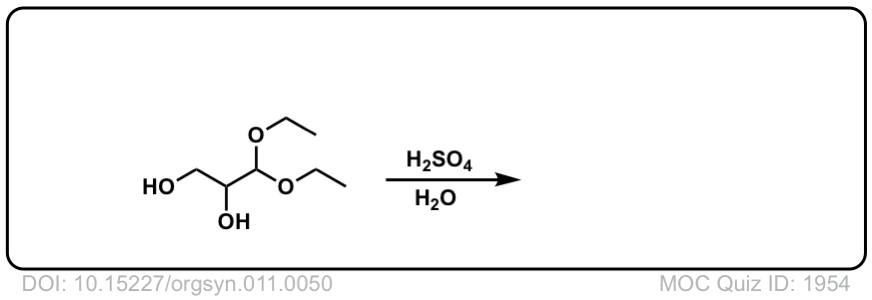
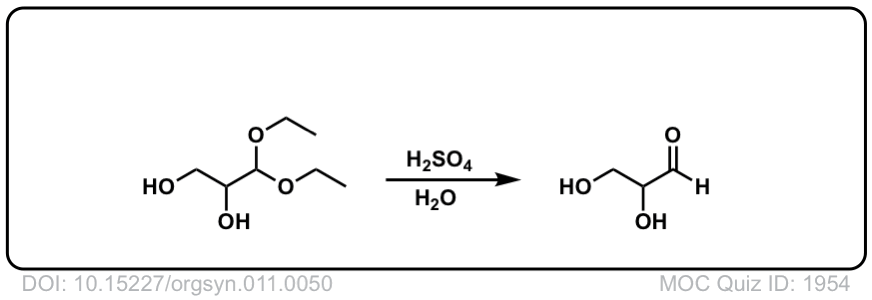
Hydrolysis of acetals to give aldehydes and ketones

Description: Addition of aqueous acid to acetals will transform them back into ketones (or aldehydes). This is often referred to as “deprotection” of ketones (or aldehydes).
[private_ReactionGuide]

Notes:

  • Acid may be written simply as “H+” . Many different acids will suffice here.
  • The reaction is an equilibrium. Water is generally used as the solvent here. Since it is present in vastly greater excess relative to alcohol, the reverse reaction is negligible.
  • Acid is catalytic
  • The reaction can be used to “protect” the carbonyl against attack, since acetals are not reactive.

Examples:

Notes: Example 3 is an example where both alcohols come from the same molecule, this makes a cyclic acetal

Mechanism: The reaction begins by protonation of one of the oxygens of the acetal (Step 1, arrows A and B), which makes a better leaving group, 1,2-elimination of the alcohol (Step 2, arrows C and D) leads to an oxonium ion, which is then attacked by water in a 1,2-addition (Step 3, arrows E and F). Proton transfer from water to alcohol (Step 4, arrows G and H) again makes the alcohol a better leaving group, which is displaced through 1,2-elimination (Step 5, arrows I and J) forming a protonated ketone. This is then deprotonated (Step 6, arrows K and L) to give the neutral ketone.

Notes:

  •  There are other reasonable mechanisms for proton transfer in step 3.
  • Furthermore there are several other species that could act as bases in step 6. TsO(–) is chosen for simplicity.
  • Although each step is reversible, single arrows are shown here for simplicity.

[/private_ReactionGuide]

{ 4 comments… read them below or add one }

Mathew September 8, 2012 at 3:22 pm

Hello – I am a bit confused about the introductory “notes” section. You state that the alcohol is used in great excess over water, but wouldn’t that lead to the formation of the acetal? I would imagine that having water in excess would drive the forward reaction instead.

Reply

james September 8, 2012 at 7:09 pm

you are right. Thanks for spotting! fixed the typo

Reply

Ali September 25, 2012 at 12:29 pm

The structure for TsOH is wrong. p-toluenesulphonic acid has a para methyl group….
cheers

Reply

james September 26, 2012 at 12:29 pm

Fixed. Thanks!

Reply

Leave a Comment