Blog
An Exercise In Mind Reading?
Last updated: September 12th, 2022 |
The other day while going through Claisen condensations with a student, we came upon this pretty typical problem:
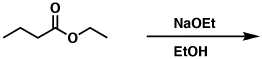
The student duly deprotonated the alpha carbon of the ester to give the enolate, but stopped there. “Since there’s just one molecule of ester, I’m not sure what it’s supposed to do next.”
I explained that it’s safe to assume that we’re doing this reaction on about a mole of the ester, which means that there are about 6 x 10²³ other molecules of ester to react with. So even though “2 equiv” isn’t written, you’re supposed to do a Claisen condensation with another molecule of ester, to give you this product:
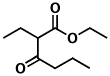
A few minutes later, we then came across this similar problem:

As before, here we deprotonate the carbon next to the ester to make the enolate. If we were to follow the logic from the previous question, we’d then perform a Claisen condensation with another molecule of the ester to give us the final product. But that, of course, isn’t what happens. Instead, the enolate adds to the ester carbonyl on the other side of the molecule, to give the 5 membered ring:
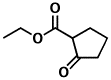
Why does it react with itself, rather than with another molecule of the starting ester? Because the ester carbonyl 4 bonds away from the enolate has a higher effective concentration, relative to the starting ester. Therefore the intramolecular reaction here is faster than the intermolecular reaction. [This is also the case when six membered rings can be formed, but not in the case where rings smaller than 5 (ring strain for 3 and 4- membered rings) or greater than 6 (ring formation starts to slow down as the reactive ends get farther apart).
Is there any other undergraduate subject which presents students with dilemmas like this, where one set of rules applies in one instance, but can be overridden by a different set of rules in another?
I could sense the frustration from the student. He’d been through nearly two semesters of organic chemistry, to the point where he was starting to feel reasonably comfortable with the course material. Yet here was yet another rule to learn, yet another exception to take note of, yet another snake hiding underneath what seemed like a perfectly innocuous rock.
“It’s almost an exercise in mind reading”, he said. “How are you supposed to know?”
We know this through experiment – and unless you do the experiment yourself, you’re going to have to rely on what you’re told in your class (or in textbooks). The reality is that hanging one little variable – like chain length – can drastically affect the outcome of the reaction. Organic chemistry is deep like that.
For someone who is just trying to get through organic chemistry in order to graduate, or needs organic chemistry for nursing, PA or nutrition school, and comes across a problem like this – they have my sympathy. They are right: organic chemistry has a lot of exceptions and tiny rules to learn, and it can be frustrating.
However, for someone who is thinking about a career in medicine – this is nothing compared to how complicated medical diagnosis can be, when you have to think across multiple variable sets and make judgements where the outcome could be life or death. So with pre-med students who encounter this type of situation- the unexpected outcome, where all our previous rules don’t apply – this is reality. And reality doesn’t care if you think it’s unnecessarily hard or not.
For some perspective on this from a physician’s perspective, see this fascinating post by Luysii where he walks through the thought process of a physician charged with the care of a diabetic patient who has just been infected with swine flu.
Find Master Organic Chemistry first when you search on Google:
this is not related to organic but I wud be grateful if u help me with the order of acidic strength in H3PO4, H3PO3, H3PO2
and also tell me why the same reason is not valid when we talk about
H2SO4 and H2SO3
or
HNO3 and HNO2
I tell my students it’s like this: you’ve been (naturally) studying OChem in your room for several hours and now you’re hungry and want to go eat dinner. Is it easier to find someone else on your floor of your dorm, or is it easier to go to the Greek house all the way across campus to find a dinner buddy? Intramolecular reactions (of any kind, Claisen/aldol, esterification, SN2, epoxide opening) tend to happen faster than intermolecular reactions (with the ring size caveats noted above).