Rearrangements
The SN1, E1, and Alkene Addition Reactions All Pass Through A Carbocation Intermediate
Last updated: November 29th, 2022 |
The Carbocation Intermediate That Connects The SN1, E1, And Alkene Addition Reactions
Was going to include this in my last post but it was getting too big.
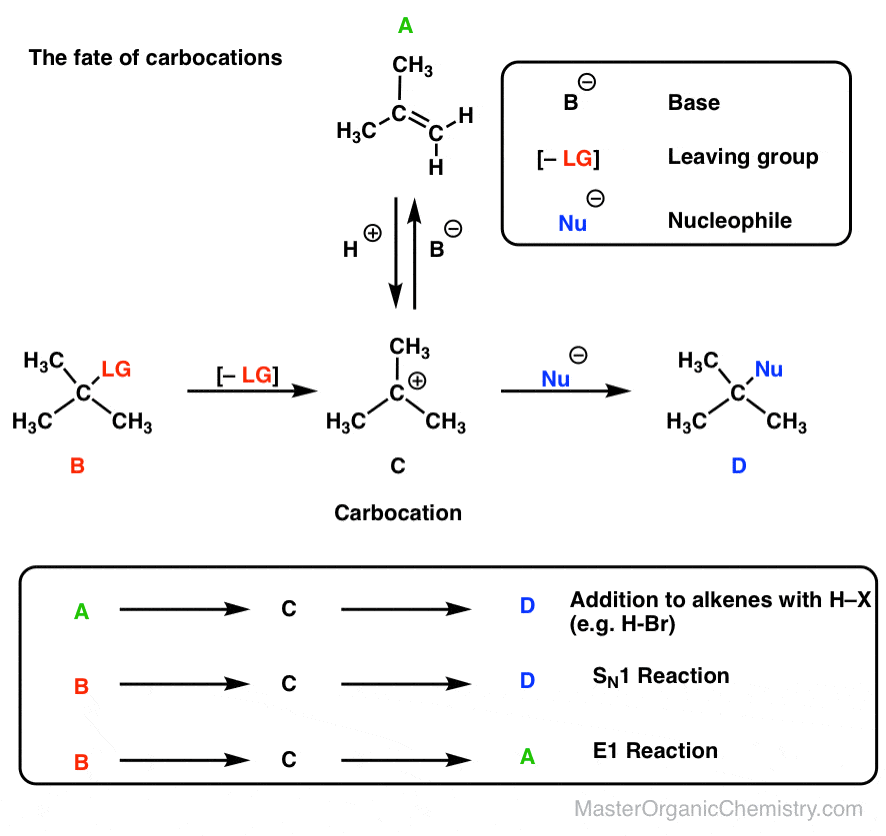
Note how the SN1, E1, and alkene addition reactions all pass through a carbocation intermediate. Here’s how they’re related.
1. The Carbocation Intermediate From Alkene Addition
Adding strong acid to an alkene gets us to a carbocation (A–>C).
If the counterion to that acid is a decent nucleophile (think Cl-, Br-, or I-) then it will then add to it, giving us the addition product D. Alternatively if we use an acid like H2SO4 (which has a poorly nucleophilic counterion) in the presence of water or another nucleophilic solvent, we can also get addition products.
The pathway A –> C –> D is an example of alkene addition.
2. The Carbocation Intermediate From The SN1 Reaction
Alternatively the carbocation can be generated through loss of a leaving group from an alkyl halide (B–> C) . Attack of that carbocation by a nucleophile (e.g. a nucleophilic solvent, again, like H2O or CH3OH) will give us a new product.
The pathway B –> C –> D is what we call the SN1 reaction.
3. The Carbocation Intermediate From The E1 Reaction
Finally, if the carbocation is generated through loss of a leaving group from an alkyl halide but there isn’t any reasonably good nucleophile present, elimination may occur to give the alkene. This is particularly favored by heat.
The pathway B –> C –> A is what we call the E1 reaction.
So there you have three very important reactions all intersecting through a common intermediate.
[Remember that leaving groups (LG) are just nucleophiles (Nu) acting in reverse. That’s why there aren’t double [equilibrium] arrows going between B, C and D]
4. What About Rearrangements?
One complication that’s left out here is carbocation rearrangements, which can arise when a less stable carbocation (often secondary) can rearrange to a more stable carbocation (often tertiary) through a hydride or alkyl shift. [See post: Rearrangement Reactions – Hydride Shifts]
Important to remember that they can occur but I couldn’t think of a way to put them in while keeping the diagram neat and tidy. :- )
Thanks for giving such a good explanation 😊😊
Glad you found it helpful.
I appreciate all your posts! They’re extremely helpful! Many thanks!
Thanks Karl!
I just want to say thank you for being able to actually make sense out of all of this. My professor has had me so confused and I actually understand you!!!! Go be a professor seriously, you make sense!