Home / Don’t Be Futyl, Learn The Butyls
Alkanes and Nomenclature
Don’t Be Futyl, Learn The Butyls
Last updated: May 28th, 2026 |
There are four different types of “butyls”, and they all have their own name.
In addition they each have a common name (“trivial name”) which they commonly go by. It’s easy to get confused. So today’s post is a guide to sorting them out.
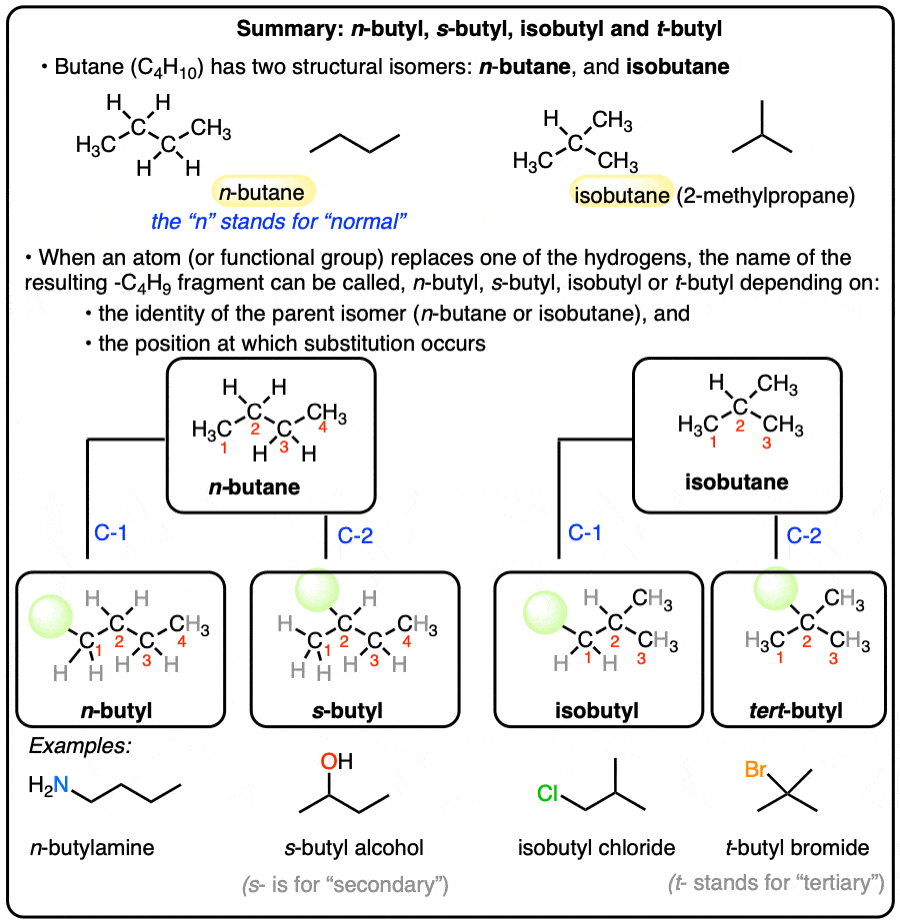
Butane has four carbons. Now there’s two potential ways to organize those carbons – the 4-carbon straight chain (n-butane), and the 3-carbon chain with a methyl group on carbon #2 (2-methyl propane, also known as “isobutane”). Don’t believe me? Try it out for yourself. There’s only two ways to do it.
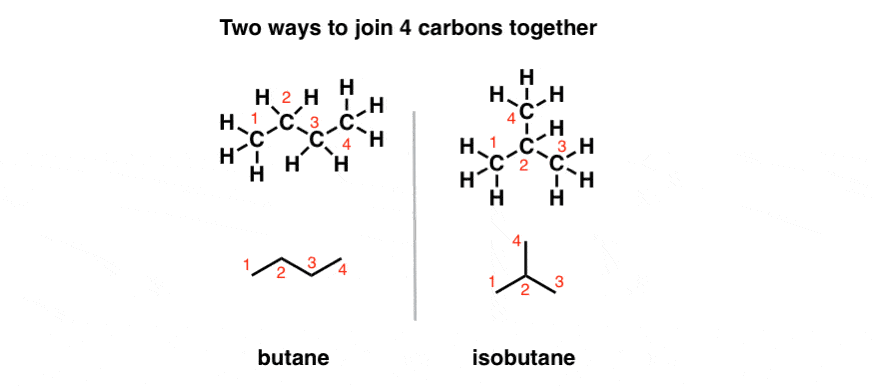
Now let’s say we have some substituent. For example, let’s make it OH. Let’s remove a hydrogen from butane and replace it with OH. If you look at n-butane, you’ll see there’s really only two ways to do it. You can take it from C-1 (or C-4), in which case you get a primary alcohol (1-butanol, or “n-butanol”). Or you can take it from C-2 (or C-3) in which case you get a secondary alcohol (2-butanol, or “sec-butanol”). We sometimes shorten that to “s-butanol”.
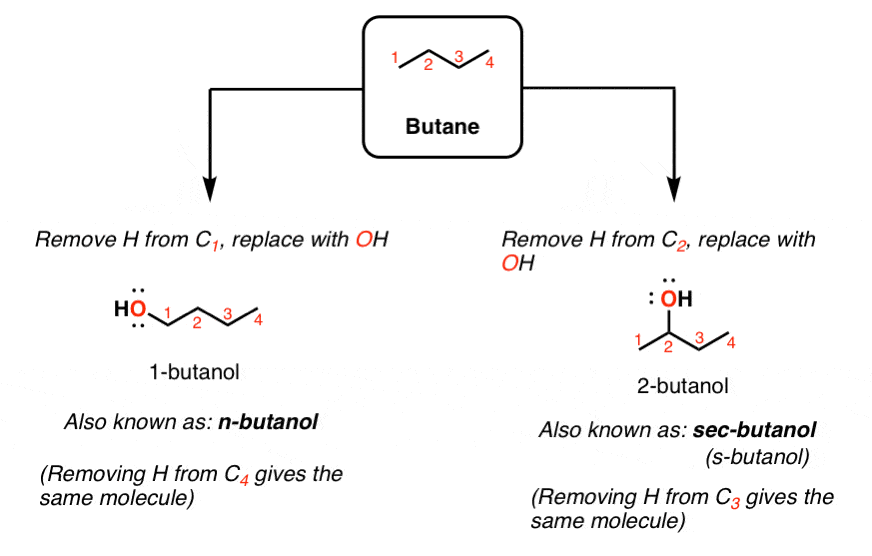
Likewise for the isobutyl skeleton there is two ways to do it. You can replace an H on C-1 (or C-3 or C-4) with OH, in which case you get 2-methyl-1-propanol (“isobutanol”). Or you can replace an H on C-2 with OH, and get 2-methyl-2-propanol (“t-butanol”). Those are the only two ways to do it!
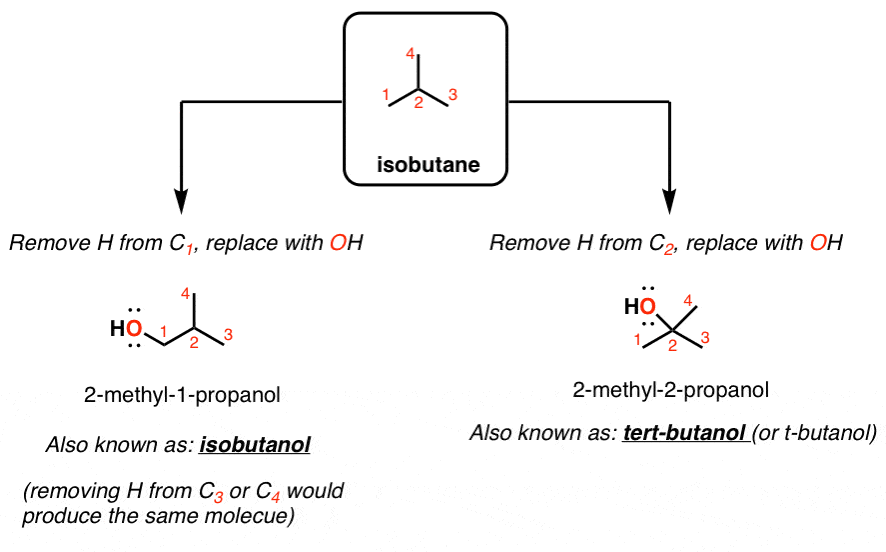
This applies to other groups too. So if we used Cl instead of OH, we’d have n-butyl chloride, s-butyl chloride, t-butyl chloride, and isobutyl chloride. And if we used some other group, those four names ( n-butyl, s-butyl, t-butyl or isobutyl ) all remain the same.
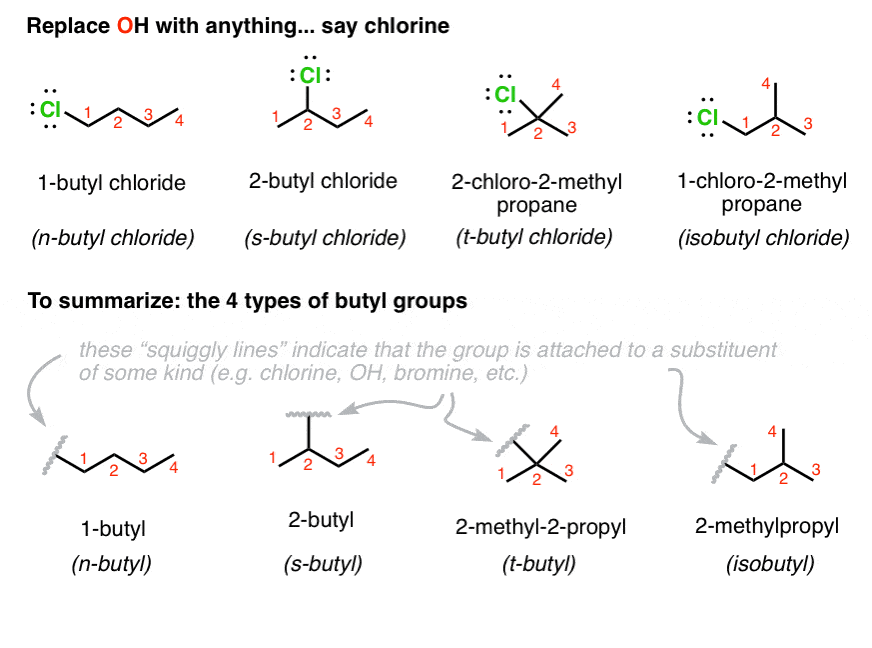
So here’s the punch line for butyl.
- 1-butyl (“n-butyl” where “n” stands for “normal”)
- 2-butyl (“s-butyl” where “s” stands for “secondary”)
- 2-methyl-1-propyl (“isobutyl”)
- 2-methyl-2-propyl (“t-butyl”)
Related Articles
Quiz Yourself!
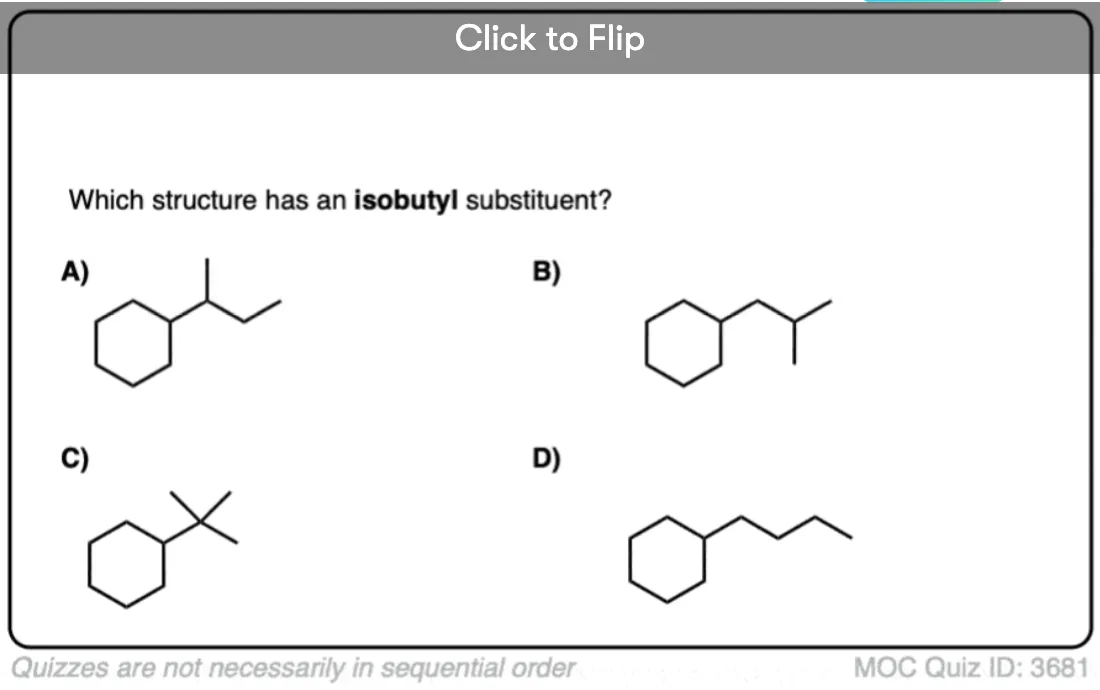
Become a MOC member to see the clickable quiz with answers on the back.
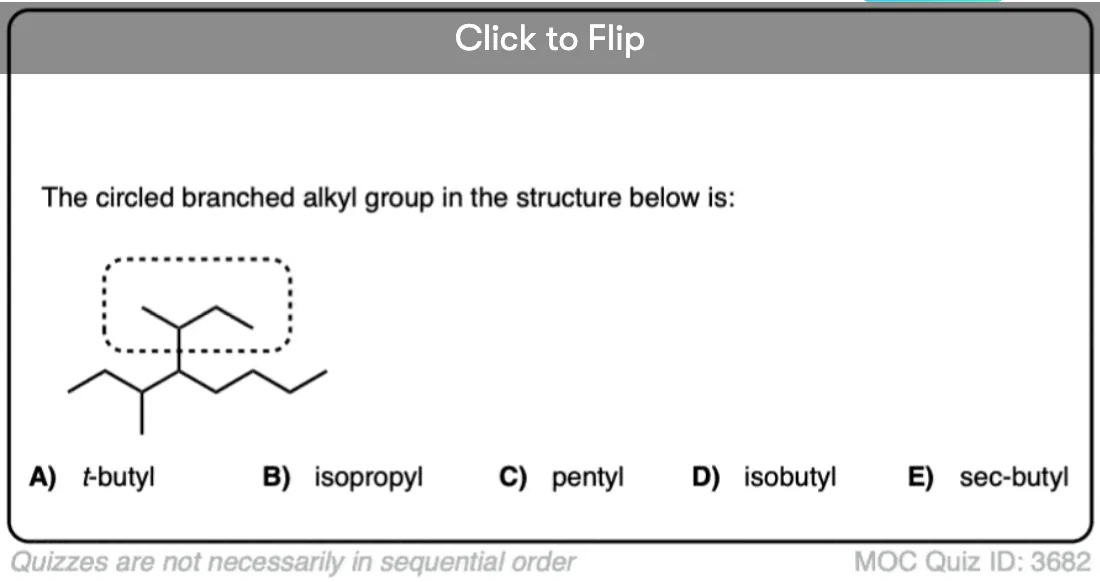
Become a MOC member to see the clickable quiz with answers on the back.
Find Master Organic Chemistry first when you search on Google:
00 General Chemistry Review
01 Bonding, Structure, and Resonance
02 Acid Base Reactions
03 Alkanes and Nomenclature
- Meet the (Most Important) Functional Groups
- Condensed Formulas: Deciphering What the Brackets Mean
- Hidden Hydrogens, Hidden Lone Pairs, Hidden Counterions
- Don't Be Futyl, Learn The Butyls
- Primary, Secondary, Tertiary, Quaternary In Organic Chemistry
- Branching, and Its Affect On Melting and Boiling Points
- The Many, Many Ways of Drawing Butane
- Wedge And Dash Convention For Tetrahedral Carbon
- Common Mistakes in Organic Chemistry: Pentavalent Carbon
- Table of Functional Group Priorities for Nomenclature
- Summary Sheet - Alkane Nomenclature
- Organic Chemistry IUPAC Nomenclature Demystified With A Simple Puzzle Piece Approach
- Boiling Point Quizzes
- Organic Chemistry Nomenclature Quizzes
What is the difference between sec butyl and iso butyl ?plz help me sir … m very confused between the two …. both of them are butyl but what is it that causes one to be called sec and other as iso?
It’s in the article. I don’t know how to make it any simpler.
What is the formula for sec-butyl alkyl group?
Sec-butyl chloride is CH3-CHCl-CH2-CH3 . So the formula for the sec-butyl group by itself would just be CH3-CH-CH2-CH3 . [C4H9]
Thank you so much for this!!! So helpful
Glad you find it helpful Winnie!
I think t-butyl stands for tertiary butyl :)
hi,
i would like to know does tetra butyl titanium differ with tetra-n-butyl titanium???
Assume that “butyl” refers to n-butyl unless told otherwise.
Thank you very much… I’ve learnt a lot of things from this website… Love it! <3
Thanks for stopping by Mohammad. Glad you found it useful. James
Sir,is there any short cuts to find no. Of isomers?
No. Just be systematic about it.
Isn’t that supposed to be 2,2-dimethylpropanol above Neopentyl alcohol?
Yes, neopentyl alcohol is a different name for 2,2-dimethylpropanol.
I haven’t getting my answer here
What’s your question?
I understood a lot but I still can’t understand t-butyl. Does ‘t’ refer to ‘tertiary’? And if it does, in isobutyl where the OH and Methyl are attached isn’t it the second carbon in the structure? Please reply. Thanks :)
Yes, “t” is short for “tertiary”.
Oh my god! Im so glad i stumbles across this website. This helps me a lot in understanding the butyl. The punch line is great. i have test tomorrow and now i can finally understand how to differentiate iso, t, and sec butyl + gains new knowledge, the neopentane! Lovely!
Why is isobutyl bromide not a secondary Alkyl halide?
The carbon attached to the bromine is itself only attached to one carbon.
in alphabetical order the prefix iso- and neo- are considerd to be the part of fundamental ne of alkyle group but prefix sec- and tert- are not considered to be part of the fundamental name. why so ???
Don’t ask me, ask IUPAC.
I have a doubt. in pentyl, wat should be the name, if Cl is attached to C-2
2-Chloropentane
What about stereo-isomers? For instance, are there not 2 forms of 2-butanol?
There are, but that subject has generally not come up by the time people learn about isomers of alkanes.
can we name text butyl (1,1-dimethylethyl)?
Yes
is it text or tert
“tert-“
What’s the difference between isobutane and secondary butane??
Remember the difference between “alkane” and “alkyl” is that we remove a hydrogen and attach “something”. For instance “methyl” is methane where an H has been removed, and we’ve stuck the remaining CH3 on something (like methyl alcohol for example)
There is no “secondary butane” but there is “sec-butyl” which is when we take a hydrogen off of C2 of butane and stick it on something.
Isobutane is the molecule formally called “2-methylpropane” . If we take a hydrogen from one of the methyl groups of isobutane and stick it on something, it is often called, “isobutyl” . For example, isobutyl chloride.
I love you for this explanatipn
Hi,
This was VERY unhelpful because you used line structures to explain shows things and I was literally unable to learn S!**. It is not because I’m a 7th grader with a pre-pubeceant boner for Orgo chem, but trying to imagine what a bunch of lines and A FUCKING SQUIGGLY line represents ON TOP of trying to learn the new nomenclature just really pisses off. I appreciate you TRYING to help, but please don’t be a lazy ass motherfucker and draw everything in lewis structure so that I don’t have to think twice as hard to learn. I’m sorry this is mean, but I have my exam in 3 hours and just realized I had to learn this and my blood pressure is THROUGH THE ROOF :)
Cordially,
JD
Can you leave out the negativity? This is a free site, you get what you pay for. Some of us are getting what we need out of it. I’m sure there are paid sites that can give you what you need, if things are that dire. As for “Cordially”..”You keep on using that word…I do not think it means what you think it means!!”
Good luck on your test.
Understanding Lewis diagrams is, possibly, the most basic skill you need for organic chemistry. Almost every resource available about o-chem depends on Lewis diagrams to explain structure and behavior.
I’m going to assume that you struggled with your exam, but best luck on learning diagrams for the next test.
Hey James!!!
I have one doubt. Both neo and tert prefixes are associated with tertiary carbons. Can you clear it out for me about when and how to use these prefixes?
Thank you !!!
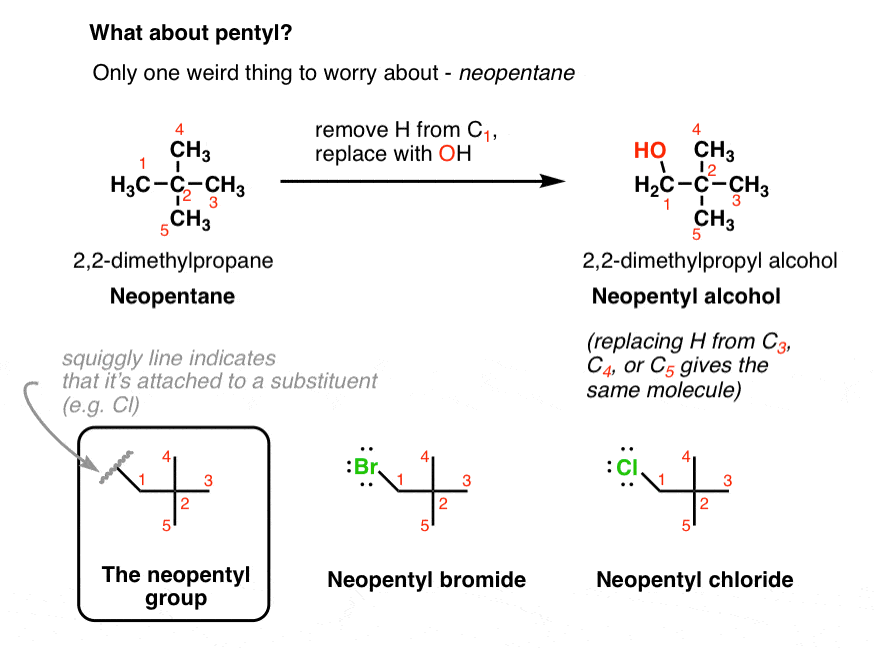
Neopentyl alcohol is a primary alcohol where the primary carbon is adjacent to t-butyl. t-butyl alcohol is a tertiary alcohol where the carbon bound to OH *is* t-butyl.
This is for u James Ashenhurst
Chain isomerism is change in skeleton.
For eg- CH3-CH2-CH2-CH2-CH3 is pentane
CH3
|
CH3-CH-CH2-CH3 is also pentane but there
is change in structure.
Whereas position isomerism is change in position of substituents.
For eg- CH3-CH2-CH2-CH2-Cl
Cl
|
CH3-CH2-CH-CH3 here u can see there is change in position of halogen chlorine
Hope my effort would clear or doubt.
I’ve got my nomenclature test tomorrow, I learn more from here than my classes.
The names isopropanol, sec-butanol and tert-butanol are incorrect, although quite spread over the scientific community. In substitutive nomenclature of alcohols the hydroxyl group as principal group is indicated by a suffix “ol”, with elision of terminal “e” (if present) from the name of the parent compound: methanol, ethanol… Isopropane, sec-butane and tert-butane don’t exist. The problem comes from the way we write these compounds: i-PrOH, s-BuOH and t-BuOH, which mean isopropyl alcohol, sec-butyl alcohol and tert-butyl alcohol, all correct names, where i-Pr, s-Bu and t-Bu stand for isopropyl, sec-butyl and tert-butyl but NEVER for isopropane, sec-butane and tert-butane. I don’t think it’s appropriate to teach people to use wrong terms, although I agree that those wrong spread names should be commented as a note. Well, this is my humble opinion…
They’re not wrong names – they’re just common names AND they are widely used so it is completely appropriate to discuss them.
They are “common wrong names”. As I wrote, they should be commented (and encourage people not to use them).
What will be the structure of t-butyl decane?? Also, iso-propyl-t-butyl acetylene?
t-butyl decane doesn’t really make any sense.
Isopropyl t-butyl acetylene is not the best way of describing the molecule, but what you’d do is build a carbon-carbon triple bond, and then put a t-butyl group on one side and an isopropyl group on the other. It would actually be 2,2,5-trimethyl-hex-2-yne.
Best find ever! Love the whole website.
This section was really helpful.. But can you assure me that these terms (sec,neo,tert,iso) will not comes for others except butane.??As in your section you were specific about butane.. You were not general
sec, tert, only apply to butane. iso applies to butyl and propyl. neo only applies to pentane.
Thank you so much. :) Helped ALOT :D
what should be the IUPAC nomenclature for t-Butyl group? In Wikipedia it is given as 1,1-dimethylethyl.I am confused
This was so helpful!
Can this apply to different carbon chains that are greater than butane?
For example is it possible to have a tert-hexanol or isoheptane?
Hi – no, it only applies to butane. There are so many isomers possible for chains higher than 4 that the prefixes “tert”, “iso” and so on would not refer to unique isomers.
Keep Up the Excellent Work! Its great to see individuals, such as yourself, helping students in need.
At the end where you go from Neopentane to Neopentyl Alcohol would the formula change to 2,2-dimethylpropanol because you added the OH?
Yes it would!
1-butylchloride should actually be called 1-chlorobutane (http://en.wikipedia.org/wiki/1-Chlorobutane)
1-butylchloride — Common naming
1-chlorobutane —IUPAC naming
…….this is just how the chemistry nomenclature is….a littale confusing (^.^)~
Very helpful. Read the section in my text several times, couldn’t figure out the difference between secondary and iso forms. Read your explanation once. Got it.
Great, glad you found it helpful!
Really helpful, thanks! I was trying to purely memorize which name went with which butyl, and I figured there had to be a logical explanation behind the name. You explained it really well.
Thanks Chloe!
I have a quesion! Are isobutyl alcohal and t butyl alcohal postition isomers or chain isomers?
Constitutional isomers. The terms “positional” and “chain” isomers are not familiar to me, but if I interpret their use correctly they are position isomers.
Actually they aren’t isomers because they don’t have the same molecular formula. Iso butyl alc.has formula c4h9o while the latter has c4h10o.
Isobutyl Alcohol’s formula is C4H10O, not C4H9O
“Anshyt” Your answer is absolutely wrong. Because alkyl group has general formula CnH2n+1 and one subsituent is attach on it. But if it ha H10 then there is no space for -OH group. So the are positional isomers of eachother
Actually they ARE isomers because they DO have the same molecular formula. both have the chemical formula: C4H10O
take a look at the 3D structure of both molecules (making sure that the structures show the Hydrogens), and count the hydrogens… you will end up with ten hydrogens total, including the hydrogen from the OH group.
sorry Anshyt, but that there are 10 hydrogens total on each. so they ARE isomers.
Thank you so much. :) Helped ALOT :D
thank you very much with your great work, we need more people like you who inspire students to try and do best….can i please get soft copy of your organic 2 notes.
thank you.
sir wat is difference between N and n in nomencluture. for eg.N Methylamine,n-butyl
capital, italicized N means that a group is attached to nitrogen. E.g. N-methylmorpoline. The lowercase n means “normal” as in, n-hexane (straight chain hexane).