Home / Number Your Carbons!
Organic Chemistry Tips and Tricks
Number Your Carbons!
Last updated: January 23rd, 2024 |
My one-sentence advice to those about to write an exam: Number your carbons.
Now go write your exam.
If you need reasons, here they are. There’s two.
First reason: if you number all the carbons in your starting compound(s), it helps you double check that you didn’t miss any in your product. Under the high stress atmosphere of an exam, it’s easy to make little mental mistakes like drawing a 4 carbon chain as a 3 carbon chain and so on. This is a quick protocol that will help to prevent that.
Second reason: When drawing products of a given reaction, numbering all the carbons helps you avoid getting lost. It’s a shame to watch students recognize where all the electron-pushing arrows are supposed to go only to draw their product incorrectly. Figuring out where the electrons are supposed to go is the hard part. Drawing the new product should be a slam dunk. Numbering really helps with this.
2 Quick examples of what I mean:
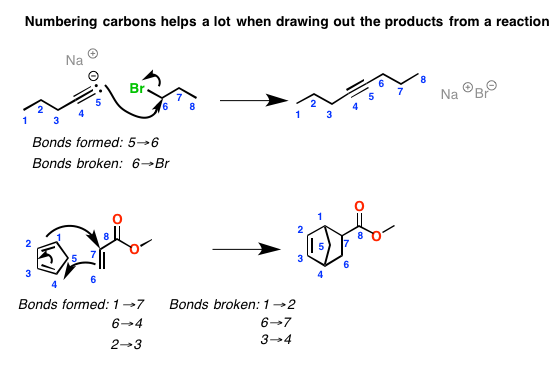
Note that when I say “number” I don’t mean do it in the “proper”, IUPAC way. I just mean label them in some way that makes each carbon unique so you know where to stitch the pieces together.
Theseus needed a ton of skill to hunt down and defeat the minotaur in the labyrinth. But in the end it was that 99 cent ball of twine that saved his butt by helping him find his way out.
Numbering the carbons is your ball of twine.
Find Master Organic Chemistry first when you search on Google:
00 General Chemistry Review
01 Bonding, Structure, and Resonance
02 Acid Base Reactions
03 Alkanes and Nomenclature
04 Conformations and Cycloalkanes
05 A Primer On Organic Reactions
06 Free Radical Reactions
07 Stereochemistry and Chirality
08 Substitution Reactions
09 Elimination Reactions
10 Rearrangements
11 SN1/SN2/E1/E2 Decision
12 Alkene Reactions
13 Alkyne Reactions
14 Alcohols, Epoxides and Ethers
15 Organometallics
16 Spectroscopy
17 Dienes and MO Theory
18 Aromaticity
19 Reactions of Aromatic Molecules
20 Aldehydes and Ketones
21 Carboxylic Acid Derivatives
22 Enols and Enolates
23 Amines
24 Carbohydrates
25 Fun and Miscellaneous
26 Organic Chemistry Tips and Tricks
- Common Mistakes: Formal Charges Can Mislead
- Partial Charges Give Clues About Electron Flow
- Draw The Ugly Version First
- Organic Chemistry Study Tips: Learn the Trends
- The 8 Types of Arrows In Organic Chemistry, Explained
- Top 10 Skills To Master Before An Organic Chemistry 2 Final
- Common Mistakes with Carbonyls: Carboxylic Acids... Are Acids!
- Planning Organic Synthesis With "Reaction Maps"
- Alkene Addition Pattern #1: The "Carbocation Pathway"
- Alkene Addition Pattern #2: The "Three-Membered Ring" Pathway
- Alkene Addition Pattern #3: The "Concerted" Pathway
- Number Your Carbons!
- The 4 Major Classes of Reactions in Org 1
- How (and why) electrons flow
- Grossman's Rule
- Three Exam Tips
- A 3-Step Method For Thinking Through Synthesis Problems
- Putting It Together
- Putting Diels-Alder Products in Perspective
- The Ups and Downs of Cyclohexanes
- The Most Annoying Exceptions in Org 1 (Part 1)
- The Most Annoying Exceptions in Org 1 (Part 2)
- The Marriage May Be Bad, But the Divorce Still Costs Money
- 9 Nomenclature Conventions To Know
- Nucleophile attacks Electrophile
man oh man do I wish I read this before my last exam (lost 5 points just from not numbering my carbons)
Thanks. It was useful for me in exam. It helped me for naming and reaction mechanism.
Good to hear. It’s such simple advice, but it can pay big dividends.
This really helped me out on my last exam, I started numbering my carbons and caught my self on one of the questions. It was a quick way of gaining a few points. When you’re powering through an exam designed to be to long to finish this really helps.