Home / The Ups and Downs of Cyclohexanes
Organic Chemistry Tips and Tricks
The Ups and Downs of Cyclohexanes
Last updated: January 23rd, 2024 |
Drawing cyclohexane chair forms can be a tricky business.
While it’s often intuitive to pick out which groups are up and down when they’re axial (i.e. pointing straight up or down), it’s tougher for beginners to see that equatorial groups (the ones pointing “somewhat up” or “somewhat down”) can be considered up or down too. I recall this as one thing that weirded me out when I saw cyclohexane chair forms for the first time.
Equatorial Groups Can Be “Up” Or “Down” Too!
Notice how the two chair forms in the figure are actually the same molecule. These two chair forms are related to each other through a “chair flip”. In the form on the left, carbon #1 (with the OH) is the “footrest” and carbon #4 (with the Cl) is the “headrest”.
In the flipped form, carbon 1 is the “headrest” and carbon 4 is the “footrest”. But the Cl is “up” and the OH is “down” in both forms.
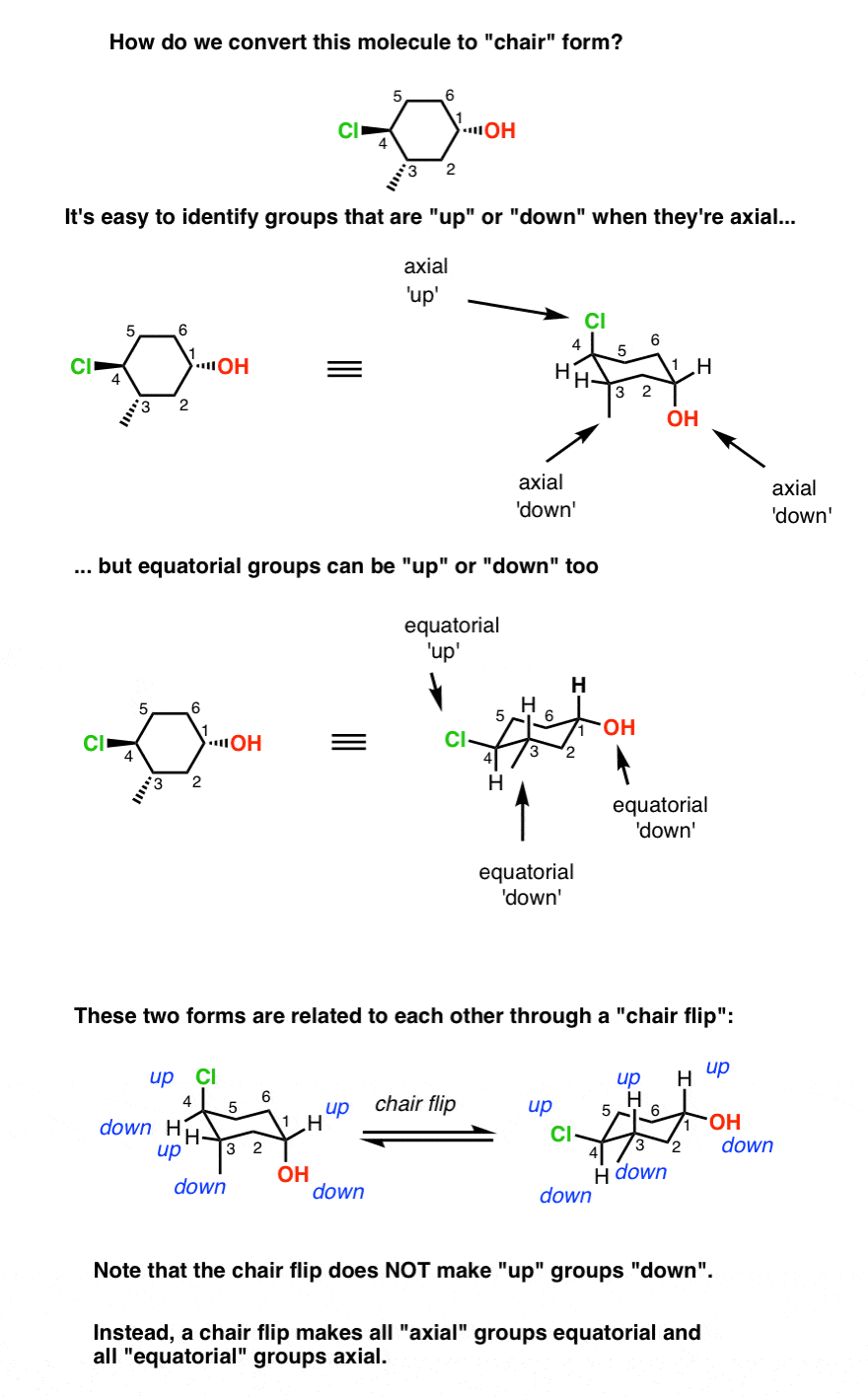
The most important thing to realize with cyclohexane chair flips is that doing a chair flip does not make an “up” group “down” or vice versa.
Instead, doing a chair flip makes every “axial” group “equatorial” and every “equatorial” group “axial”.
00 General Chemistry Review
01 Bonding, Structure, and Resonance
02 Acid Base Reactions
03 Alkanes and Nomenclature
04 Conformations and Cycloalkanes
05 A Primer On Organic Reactions
06 Free Radical Reactions
07 Stereochemistry and Chirality
08 Substitution Reactions
09 Elimination Reactions
10 Rearrangements
11 SN1/SN2/E1/E2 Decision
12 Alkene Reactions
13 Alkyne Reactions
14 Alcohols, Epoxides and Ethers
15 Organometallics
16 Spectroscopy
17 Dienes and MO Theory
18 Aromaticity
19 Reactions of Aromatic Molecules
20 Aldehydes and Ketones
21 Carboxylic Acid Derivatives
22 Enols and Enolates
23 Amines
24 Carbohydrates
25 Fun and Miscellaneous
26 Organic Chemistry Tips and Tricks
- Common Mistakes: Formal Charges Can Mislead
- Partial Charges Give Clues About Electron Flow
- Draw The Ugly Version First
- Organic Chemistry Study Tips: Learn the Trends
- The 8 Types of Arrows In Organic Chemistry, Explained
- Top 10 Skills To Master Before An Organic Chemistry 2 Final
- Common Mistakes with Carbonyls: Carboxylic Acids... Are Acids!
- Planning Organic Synthesis With "Reaction Maps"
- Alkene Addition Pattern #1: The "Carbocation Pathway"
- Alkene Addition Pattern #2: The "Three-Membered Ring" Pathway
- Alkene Addition Pattern #3: The "Concerted" Pathway
- Number Your Carbons!
- The 4 Major Classes of Reactions in Org 1
- How (and why) electrons flow
- Grossman's Rule
- Three Exam Tips
- A 3-Step Method For Thinking Through Synthesis Problems
- Putting It Together
- Putting Diels-Alder Products in Perspective
- The Ups and Downs of Cyclohexanes
- The Most Annoying Exceptions in Org 1 (Part 1)
- The Most Annoying Exceptions in Org 1 (Part 2)
- The Marriage May Be Bad, But the Divorce Still Costs Money
- 9 Nomenclature Conventions To Know
- Nucleophile attacks Electrophile
1,3 diaxial interactions renders the conformation less stable due to higher energy.
Yes.
Might be worth mentioning that equatorial groups are more stable than axial ones, too.
:)
True! Didn’t fit in here though. Soon!
If they’re substituted with groups, it’s more stable due to 1,3-diaxial strain, a form of torsional strain.