Home / Are these molecules conjugated?
Dienes and MO Theory
Are these molecules conjugated?
Last updated: May 7th, 2026 |
If Org 2 has an overall theme, it’s “resonance”. Today’s post has a very simple message. Atoms with lone pairs, π bonds, radicals, and carbocations can participate in resonance: atoms that lack any of these features cannot.
One way in which this comes up is in determining whether two alkenes are “conjugated” or not. A full discussion of conjugation is for another time, but “conjugation” is the name we give for the phenomenon where π electrons (that is, “electrons in p orbitals”) can be shared over more than 3 or more atoms.
Here’s an example of a conjugated diene and a non-conjugated dienes.
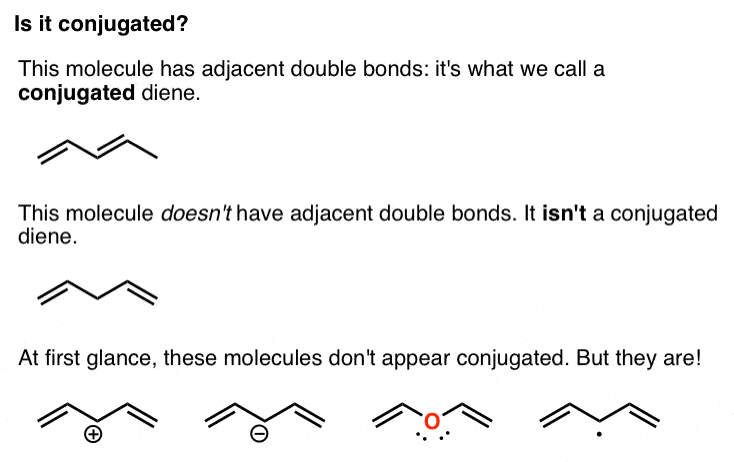
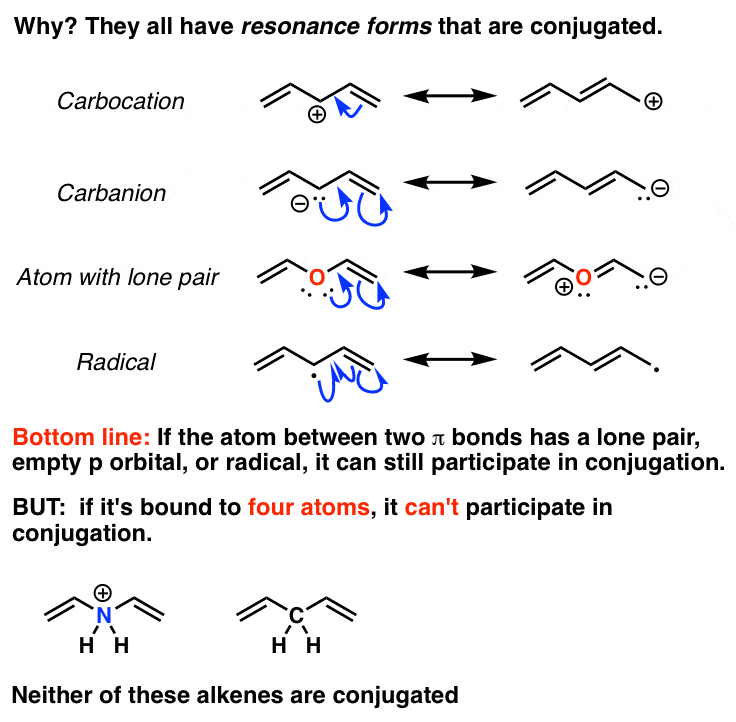
The thing is, we can also have alkenes which are conjugated with each other even through they are not directly attached. The only requirement is that we require an atom in between which can participate in resonance. This can take at least four forms:
- A carbon (or other atom) with an empty p orbital (e.g. a carbocation)
- A carbon with a half-filled p orbital (e.g. a radical)
- A carbon with a lone pair (carbanion)
- Any other atom with a lone pair (e.g. N, O, S, etc.)
In each of these we can draw resonance forms where the middle atom participates in a π bond. This implies that the electrons are being shared (“delocalized”) between this central atom and the alkenes on the side, and thus the whole system is ‘conjugated’.
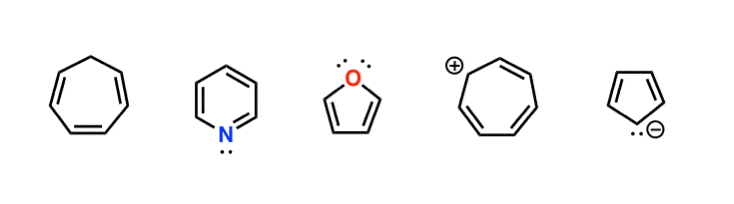
Why does this matter, you may ask? Because some day, I have a hunch that you might be asked whether the following rings are conjugated or not, and you might need to come up with a good answer….
Quiz Yourself!

Become a MOC member to see the clickable quiz with answers on the back.

Become a MOC member to see the clickable quiz with answers on the back.
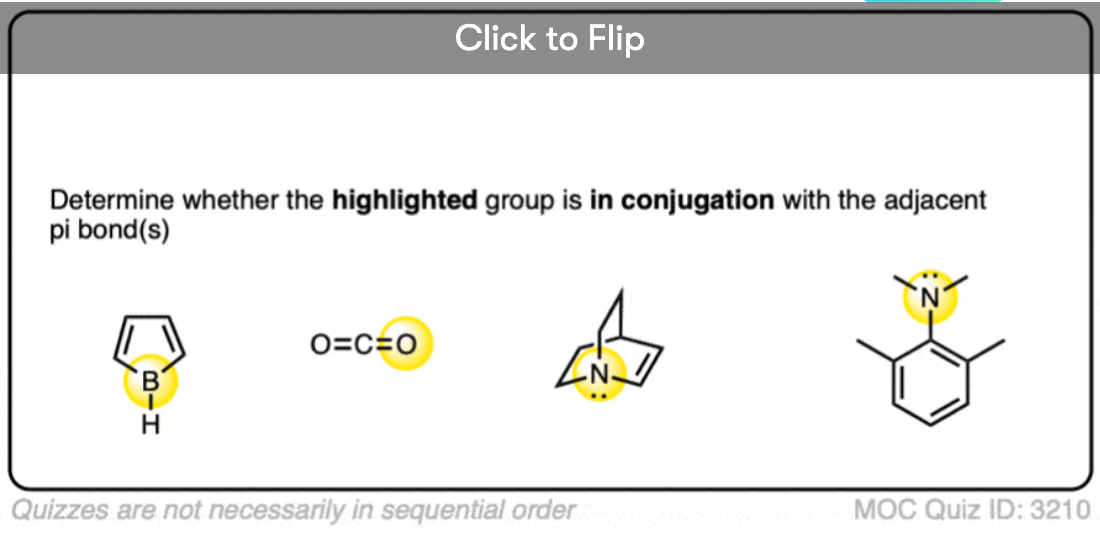
Become a MOC member to see the clickable quiz with answers on the back.
00 General Chemistry Review
01 Bonding, Structure, and Resonance
02 Acid Base Reactions
03 Alkanes and Nomenclature
04 Conformations and Cycloalkanes
05 A Primer On Organic Reactions
06 Free Radical Reactions
07 Stereochemistry and Chirality
08 Substitution Reactions
09 Elimination Reactions
10 Rearrangements
11 SN1/SN2/E1/E2 Decision
12 Alkene Reactions
13 Alkyne Reactions
14 Alcohols, Epoxides and Ethers
15 Organometallics
16 Spectroscopy
17 Dienes and MO Theory
- What To Expect In Organic Chemistry 2
- Are these molecules conjugated?
- Conjugation And Resonance In Organic Chemistry
- Bonding And Antibonding Pi Orbitals
- Molecular Orbitals of The Allyl Cation, Allyl Radical, and Allyl Anion
- Pi Molecular Orbitals of Butadiene
- Reactions of Dienes: 1,2 and 1,4 Addition
- Thermodynamic and Kinetic Products
- More On 1,2 and 1,4 Additions To Dienes
- s-cis and s-trans
- The Diels-Alder Reaction
- Cyclic Dienes and Dienophiles in the Diels-Alder Reaction
- Stereochemistry of the Diels-Alder Reaction
- Exo vs Endo Products In The Diels Alder: How To Tell Them Apart
- HOMO and LUMO In the Diels Alder Reaction
- Why Are Endo vs Exo Products Favored in the Diels-Alder Reaction?
- Diels-Alder Reaction: Kinetic and Thermodynamic Control
- The Retro Diels-Alder Reaction
- The Intramolecular Diels Alder Reaction
- Regiochemistry In The Diels-Alder Reaction
- The Cope and Claisen Rearrangements
- Electrocyclic Reactions
- Electrocyclic Ring Opening And Closure (2): Six (or Eight) Pi Electrons
- Diels Alder Practice Problems
- Molecular Orbital Theory Practice
Love the information and I always get a good laugh out of it!
Thank you sooo much sir..
Thanks for sharing, I’ve been struggling with chemistry for a very long time. Your website is very helpful!
Thank you so much for this great resource!
Glad you find it helpful!
Hey,
This is so helpful content. It is so informative content. It is a higher level of readable content. Students can easily realize the topic by reading this content. As a textile chemistry specialist I can say is the most info content ever seen.
THis is
Md. Kamrul Islam
B.Sc in textile engineering (Specialization in textile chemistry)
Blogger of https://practicaltextile.com/
Thank you very much sir!!
Thank you very much your site is a great support for my studies
Glad to hear it Rasheema.
I cannot thank you enough for these posts! I can only imagine how much time and energy it takes to create them. Know that you are helping students so much and that we so appreciate it!
Love your posts
They are awesome
Made me best in organic chemistry in my class
Can the electrons in a triple bond participate in resonance/conjugation? I expect so because they’re just part of another p orbital, but nothing I’ve read has explicitly sanctioned that.
Yes, of course! However as you touched on, the two pi bonds on the alkyne are at 90 degree angles to each other, so only one pi bond will be able to interact with any given adjacent pi system.
For the carbanion resonance structure, the lone pair is on the last carbon. That carbon has 1 C-C bond, 2 C-H bonds, and a lone pair. So wouldn’t that technically be sp3? or is it because its a resonance structure, so the the true structure is something in between the two resonance structures and therefore sp2?
sir please explain isolated,congugate and cumulated type differentiate among them
That’s something you can google.
Thanks for helping to understand conjugated and not conjugated molecules.
Thank you so much for this great resource!
How can I differentiate conjugated polymer and non-conjugated polymer
Thanks
Do you notice multiple adjacent pi bonds that are not interrupted by sigma bonds?
I have a doubt regarding the stability of conjugated systems. In general, will a cross conjugated system be more or less stable when compared to one that is continuously conjugated?
For eg, consider 1-methylene-2,4-cyclohexadiene and 1-methylene-2,5-cyclohexadiene. Which would be the more stable alkene?
Whats the answers to the structure above.
The key point comes up in the context of “aromaticity”. In order for a molecule to be aromatic, ALL of the carbons of the ring have to be able to participate in resonance. In the question at the bottom of the post, can you see any rings where there are carbons that CAN’T participate in resonance ? : – )
So all of it can form resonance except the first one?
For the purposes of determining aromaticity, the first one is not conjugated all the way around the ring. The others are.
I’m so glad you put the “exceptions” to the rule on your posts. My teacher always forgets to tell us when the rule doesn’t apply, and I always come to your blog to gain a better understanding of the material. Thanks!
This is really helpful, I’m going over this to help refresh my chemistry knowledge whilst studying for the MCAT! I hope you add more lessons!
Glad you’ve found the website useful Ashley!
Thank you for helping me remember my Chemistry!
Thank you so much! I am in Orgo II right now and am struggling but these really help me a lot!
Glad it was helpful Danielle!
Thank you for your posts!!! AND your website! I love that I’m able to access all the information for free. I’ve been struggling with chemistry for a very long time. Your website is very helpful!
Thanks Binh.
I would have loved it if you explained this phenomenon in terms of vbt n mot
your posts are very helpful to me sir,thank u somuch
I love your posts, they’re always informative! Thanks!
Thanks!