Home / A Key Skill: How to Calculate Formal Charge
Bonding, Structure, and Resonance
A Key Skill: How to Calculate Formal Charge
Last updated: March 6th, 2025 |
How To Calculate Formal Charge
To calculate the formal charge of an atom, we start by:
- evaluating the number of valence electrons (VE) the neutral atom has (e.g. 3 for boron, 4 for carbon, 5 for nitrogen, and so on). (note: this is also equivalent to the effective nuclear charge Zeff , the number of protons that an electron in the valence orbital “sees” due to screening by inner-shell electrons.)
- counting the number of non-bonded valence electrons (NBE) on the atom. Each lone pair counts as 2, and each unpaired electron counts as 1.
- counting the number of bonds (B) to the atom, or alternatively, counting the number of bonding electrons and dividing this by 2.
The formal charge FC is then calculated by subtracting NBE and B from VE.
FC = VE – (NBE + B)
which is equivalent to
FC = VE – NBE – B
The calculation is pretty straightforward if all the information is given to you. However, for brevity’s sake, there are many times when lone pairs and C-H bonds are not explicitly drawn out.
So part of the trick for you will be to calculate the formal charge in situations where you have to take account of implicit lone pairs and C-H bonds.
In the article below, we’ll address many of these situations. We’ll also warn you of the situations where the calculated formal charge of an atom is not necessarily a good clue as to its reactivity, which is extremely important going forward.
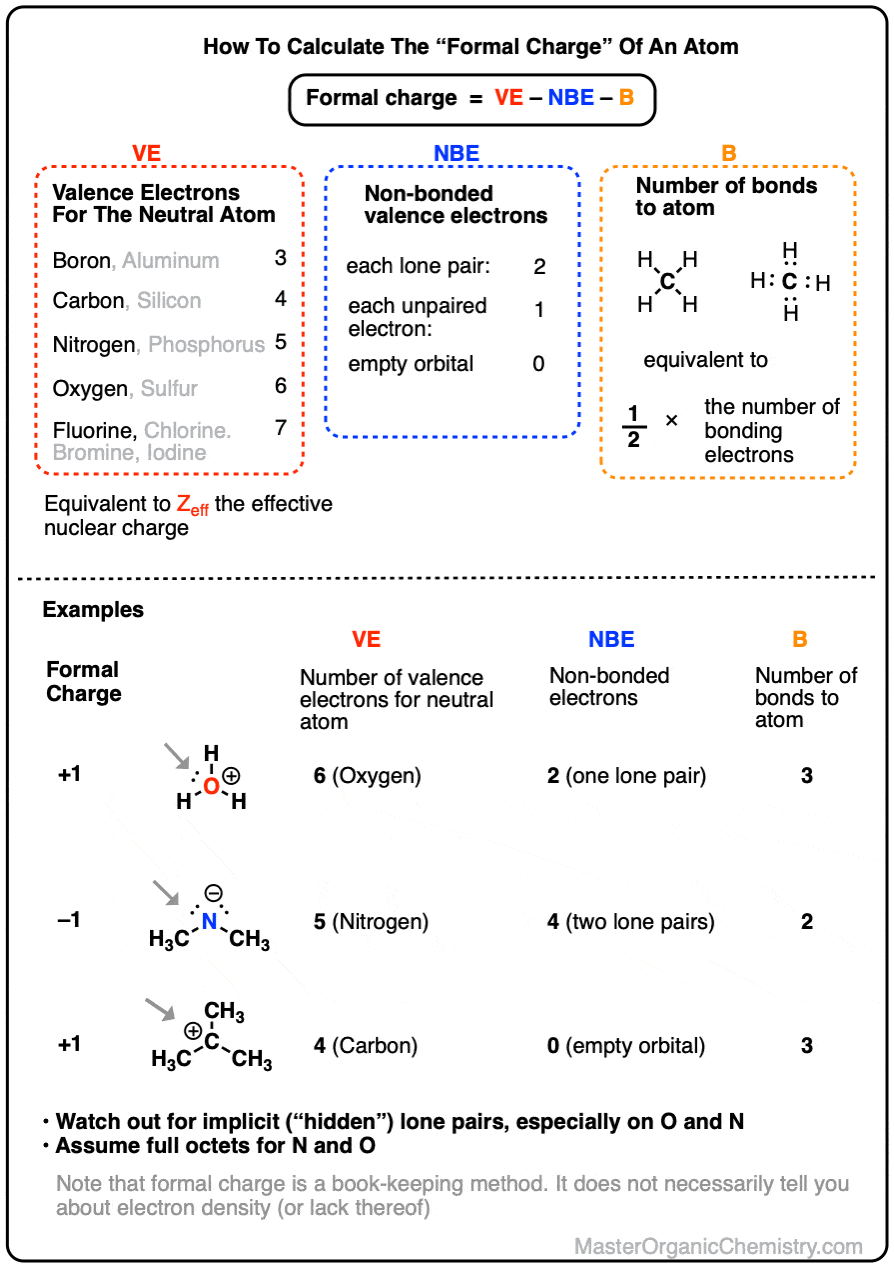
Table of Contents
- Formal Charge
- Simple Examples For First-Row Elements
- Formal Charge Calculations When You Aren’t Given All The Details
- Some Classic Formal Charge Problems
- Formal Charges and Curved Arrows
- Halogens
- Conclusion
- Notes
- Quiz Yourself!
- (Advanced) References and Further Reading
1. Formal Charge
Formal charge is a book-keeping formalism for assigning a charge to a specific atom.
To obtain the formal charge of an atom, we start by counting the number of valence electrons [Note 1] for the neutral atom, and then subtract from it the number of electrons that it “owns” (i.e. electrons in lone pairs, or singly-occupied orbitals) and half of the electrons that it shares (half the number of bonding electrons, which is equivalent to the number of bonds)
The simplest way to write the formula for formal charge (FC) is:
FC = VE – NBE – B
where
- VE corresponds to the number of electrons around the neutral atom (3 for boron, 4 for carbon, 5 for nitrogen, 6 for oxygen, 7 for fluorine)
- NBE corresponds to the number of non-bonded electrons around the atom (2 for a lone pair, 1 for a singly-occupied orbital, 0 for an empty orbital)
- B is the number of bonds around the atom (equivalent to half the number of bonding electrons)
It’s called “formal” charge because it assumes that all bonding electrons are shared equally. It doesn’t account for electronegativity differences (i.e. dipoles).
For that reason formal charge isn’t always a good guide to where the electrons actually are in a molecule and can be an unreliable guide to reactivity. We’ll have more to say on that below.
2. Simple Examples For First-Row Elements
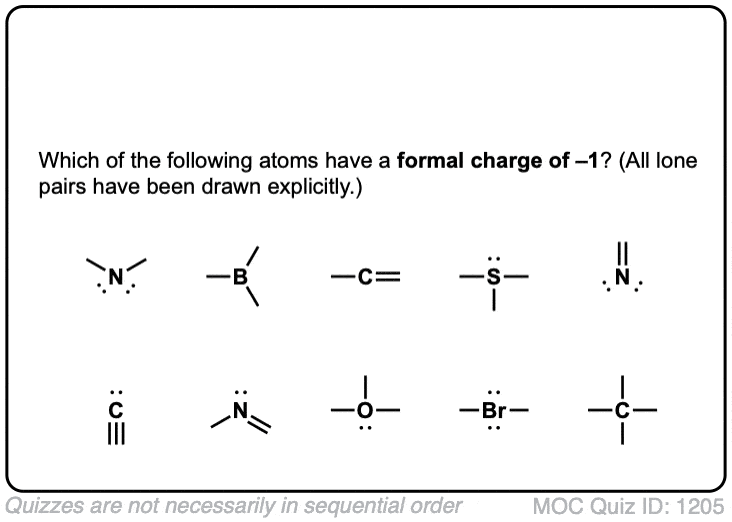
When all the lone pairs are drawn out for you, calculating formal charge is fairly straightforward.
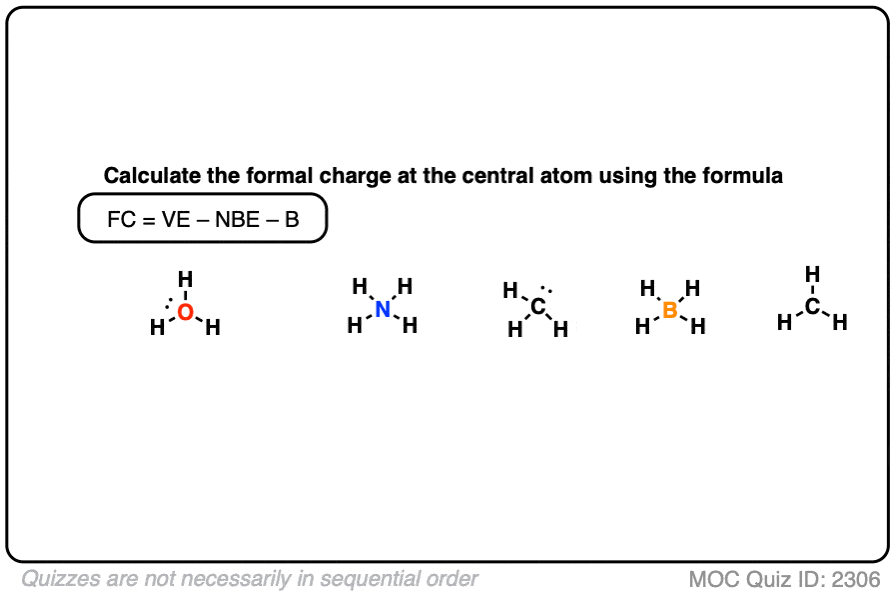
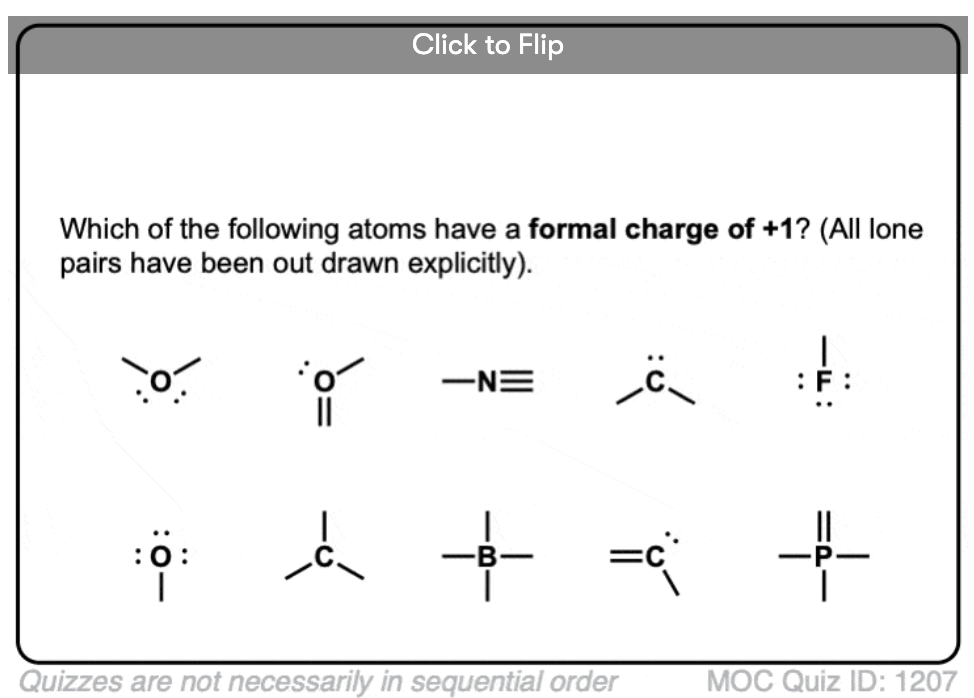
Let’s work through the first example in the quiz below.
- In the hydronium ion (H3O) the central atom is oxygen, which has 6 valence electrons in the neutral atom
- The central atom has 2 unpaired electrons and 3 bonds
- The formal charge on oxygen is [6 – 2 – 3 = +1 ] giving us H3O+
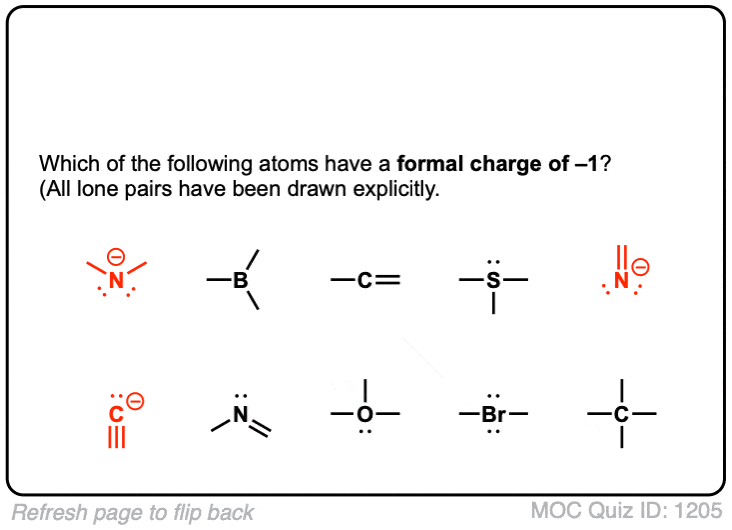
See if you can fill in the rest for the examples below.
 Click to Flip
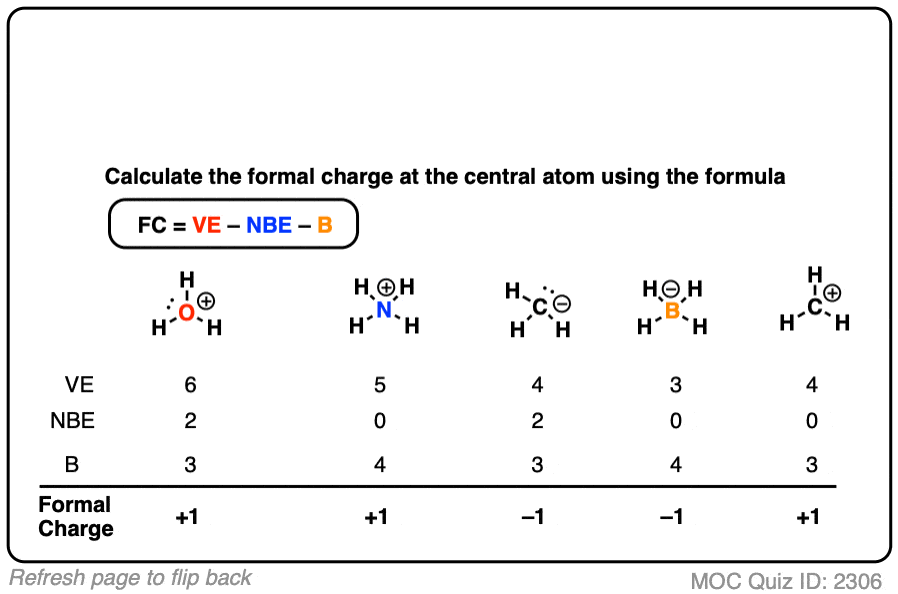
If that went well, you could try filling in the formal charges for all of the examples in this table.
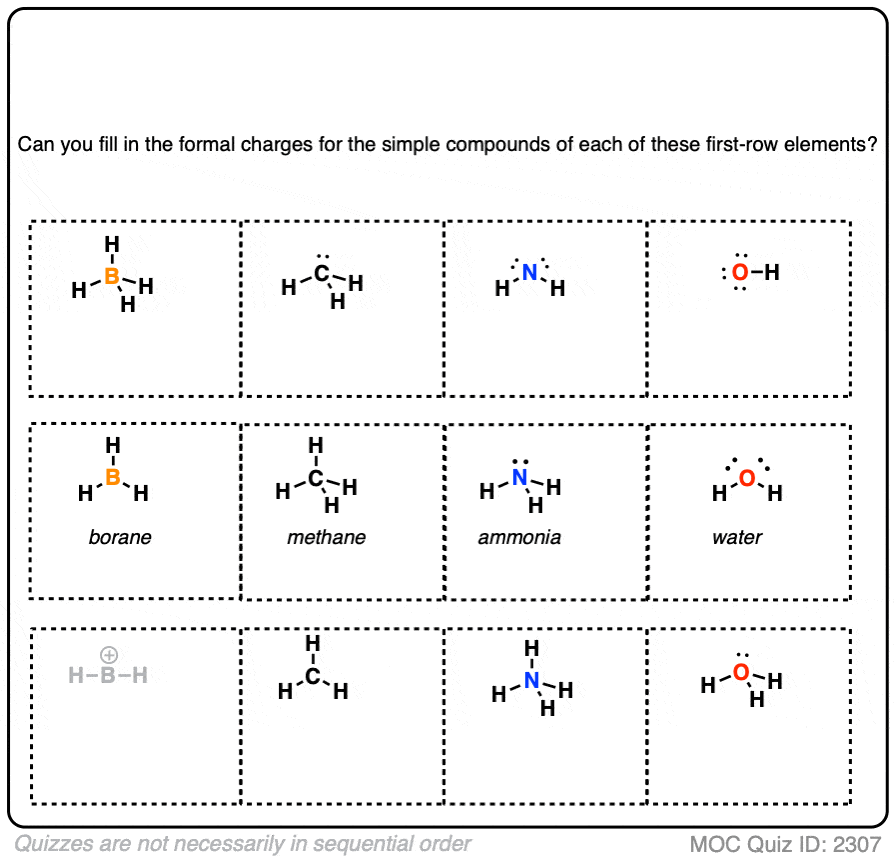
Become a member to see the clickable quiz with answers on the back.
It will take some getting used to formal charge, but after a period of time it will be assumed that you understand how to calculate formal charge, and that you can recognize structures where atoms will have a formal charge.
Let’s deal with some slightly trickier cases.
3. Formal Charge Calculations When You Aren’t Given All The Details
When we draw a stick figure of a person and don’t draw in their fingers, it doesn’t mean we’re drawing someone who had a bad day working with a table saw. We just assume that you could fill in the fingers if you really needed to, but you’re skipping it just to save time.
Chemical line drawings are like stick figures. They omit a lot of detail but still assume you know that certain things are there.
- With carbon, we often omit drawing hydrogens. You’re still supposed to know that they are there, and add as many hydrogens as necessary to give a full octet (or sextet, if it’s a carbocation).
- If there is a lone pair or unpaired electron on a carbon, it’s always drawn in.
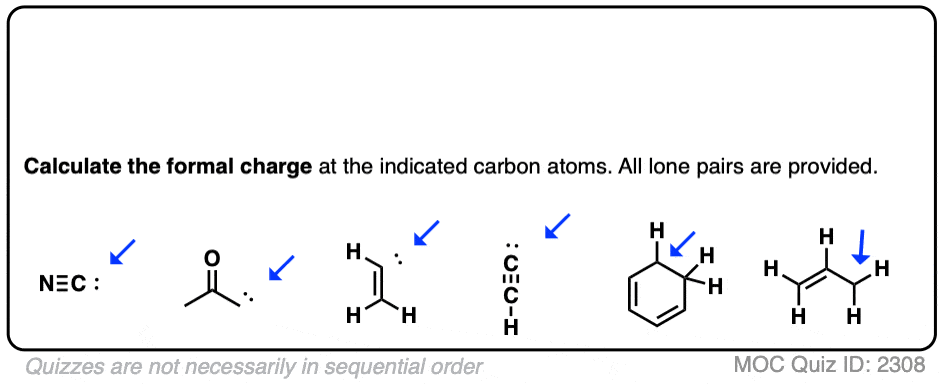 Click to Flip
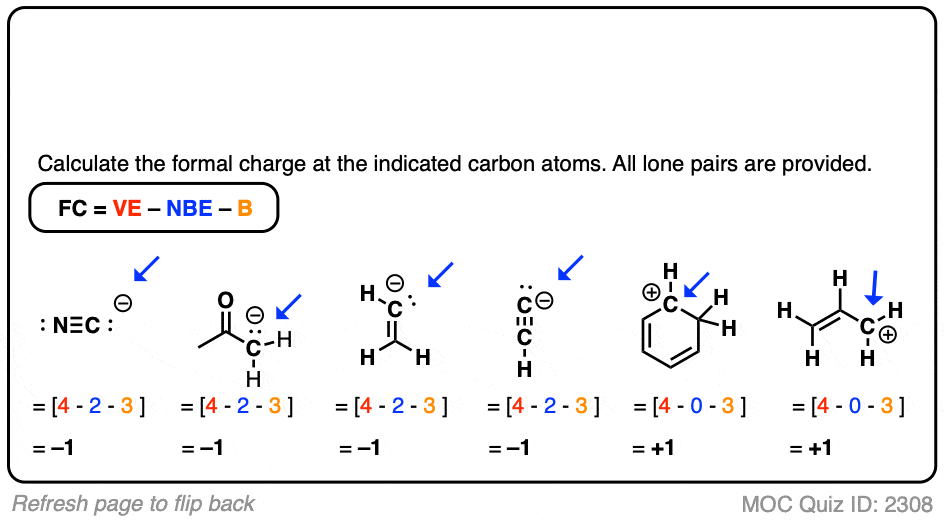
One note. If we draw a stick figure, and we do draw the fingers, and took the time to only draw in only 3, then we can safely assume that the person really does only have 3 fingers. So in the last two examples on that quiz we had to draw in the hydrogens in order for you to know that it was a carbocation, otherwise you would have to assume that it had a full octet!
Oxygen and nitrogen (and the halogens) are dealt with slightly differently.
- Bonds to hydrogen are always drawn in.
- The lone pairs that are often omitted.
- Nitrogen and oxygen will always have full octets. Always. [Note 2 – OK, two exceptions]
So even when the lone pairs aren’t drawn in, assume that enough are present to make a full octet. And when bonds from these atoms to hydrogen are missing, that means exactly what it seems to be: there really isn’t any hydrogen!
Try these examples:
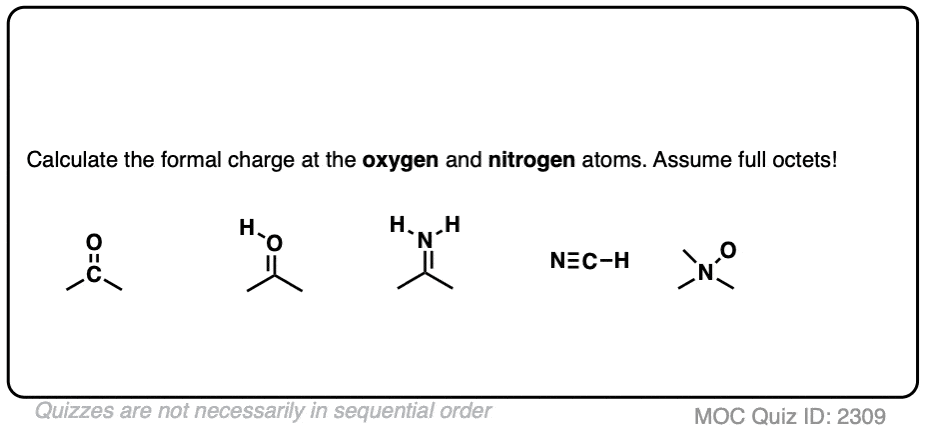 Click to Flip
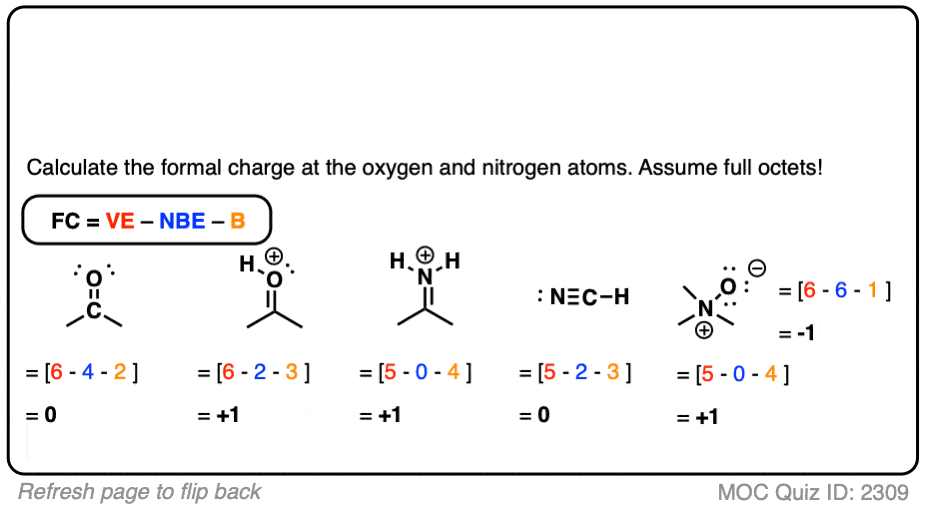
Now see if you can put these examples together!
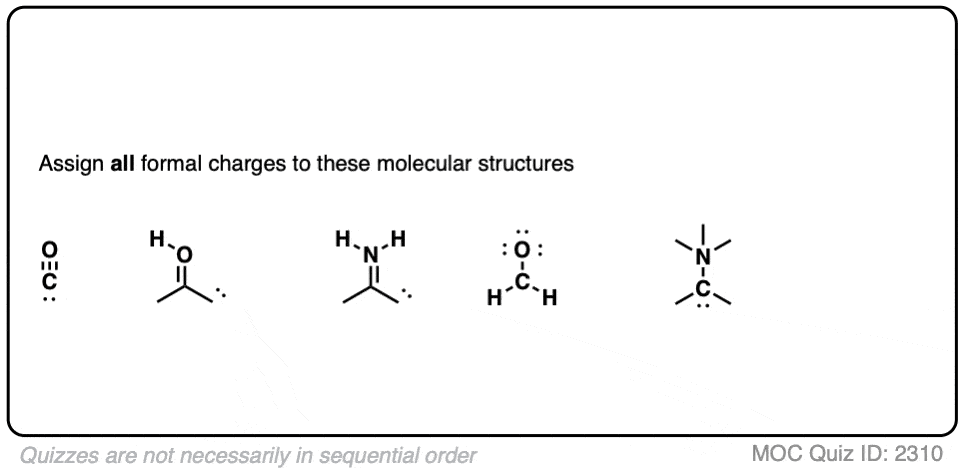 Click to Flip
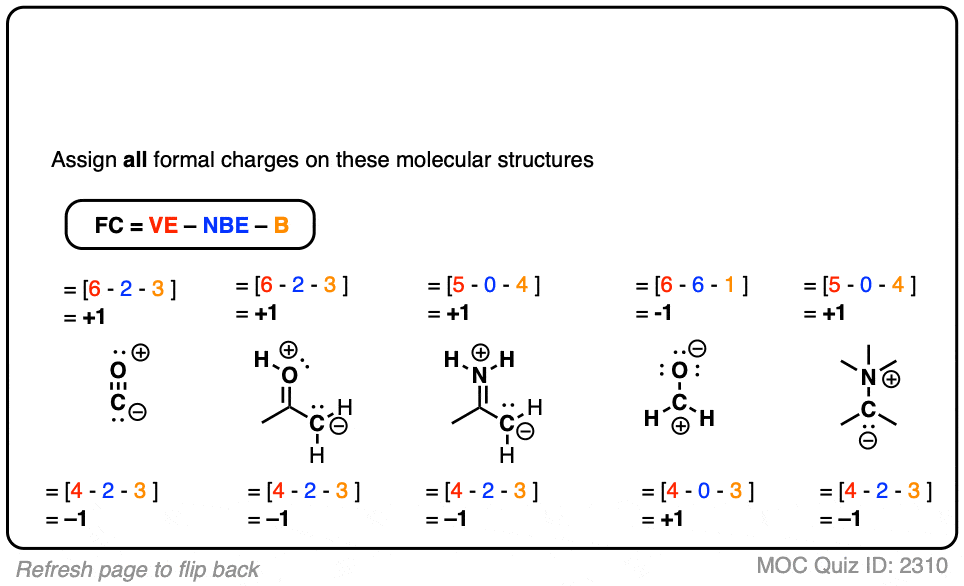
(Note that some of these are not stable molecules, but instead represent are resonance forms that you will encounter at various points during the course!)
4. Some Classic Formal Charge Questions
We can use the exact same formal charge formula, above, along with the rules for implicit lone pairs and hydrogens, to figure out the formal charge of atoms in some pretty exotic-looking molecules.
Here are some classic formal charge problems.
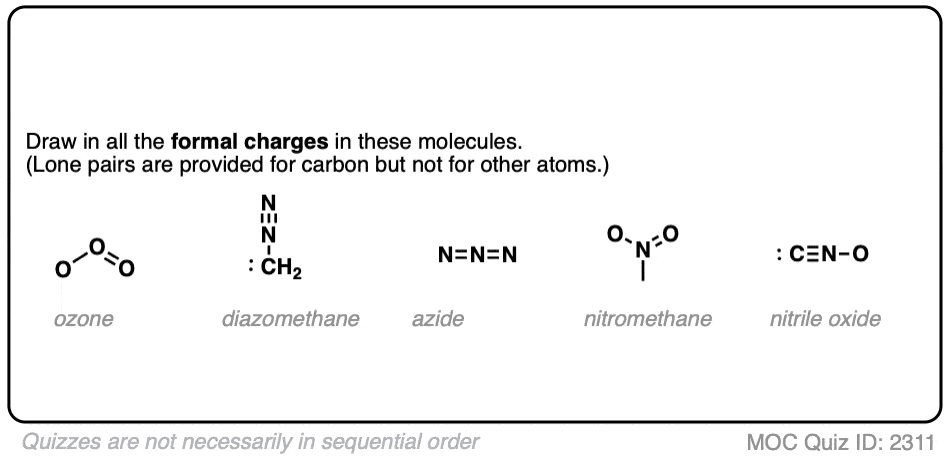 Click to Flip
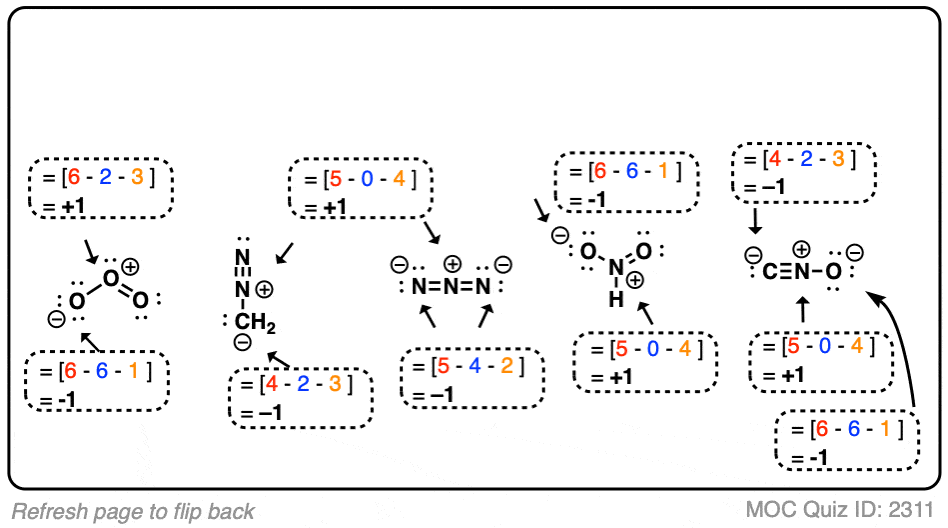
Note that although the structures might look weird, the formal charge formula remains the same.
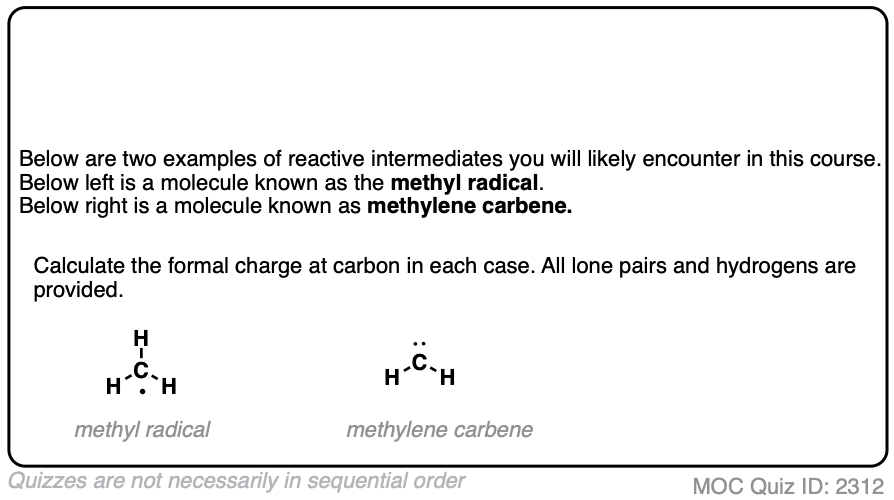
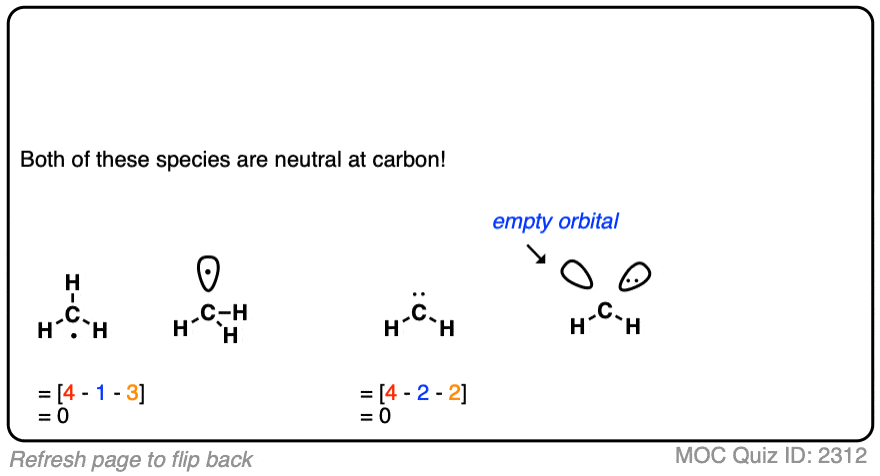
The formal charge formula can even be applied to some fairly exotic reactive intermediates we’ll meet later in the semester.
Don’t get spooked out. Just count the electrons and the bonds, and that will lead you to the right answer.
 Click to Flip
5. Formal Charges and Curved Arrows
We use curved arrows to show the movement of electron pairs in reactions and in resonance structures. (See post: Curved Arrows For Reactions)
For example, here is a curved arrow that shows the reaction of the hydroxide ion HO(-) with a proton (H+).
The arrow shows movement of two electrons from oxygen to form a new O–H bond.
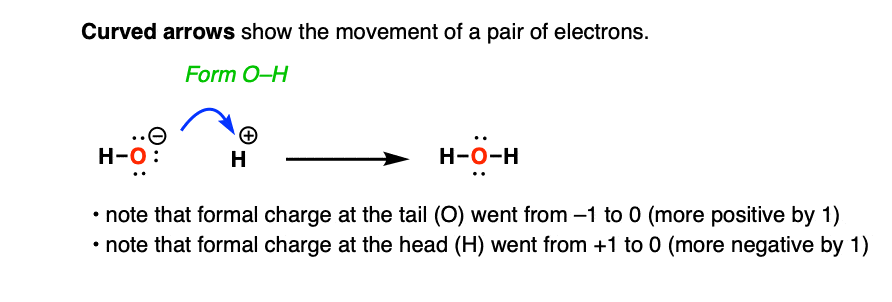
Curved arrows are also useful for keeping track of changes in formal charge. Note that the formal charge at the initial tail of the curved arrow (the oxygen) becomes more positive (from -1 to 0) and the formal charge at the final tail (the H+) becomes more negative (from +1 to 0).
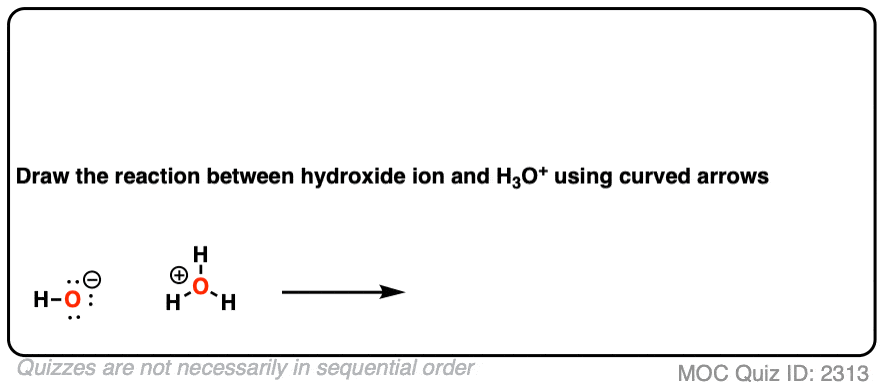
When acid is added to water, we form the hydronium ion, H3O+.
Here’s a quiz. See if you can draw the curved arrow going from the hydroxide ion to H3O+.
 Click to Flip
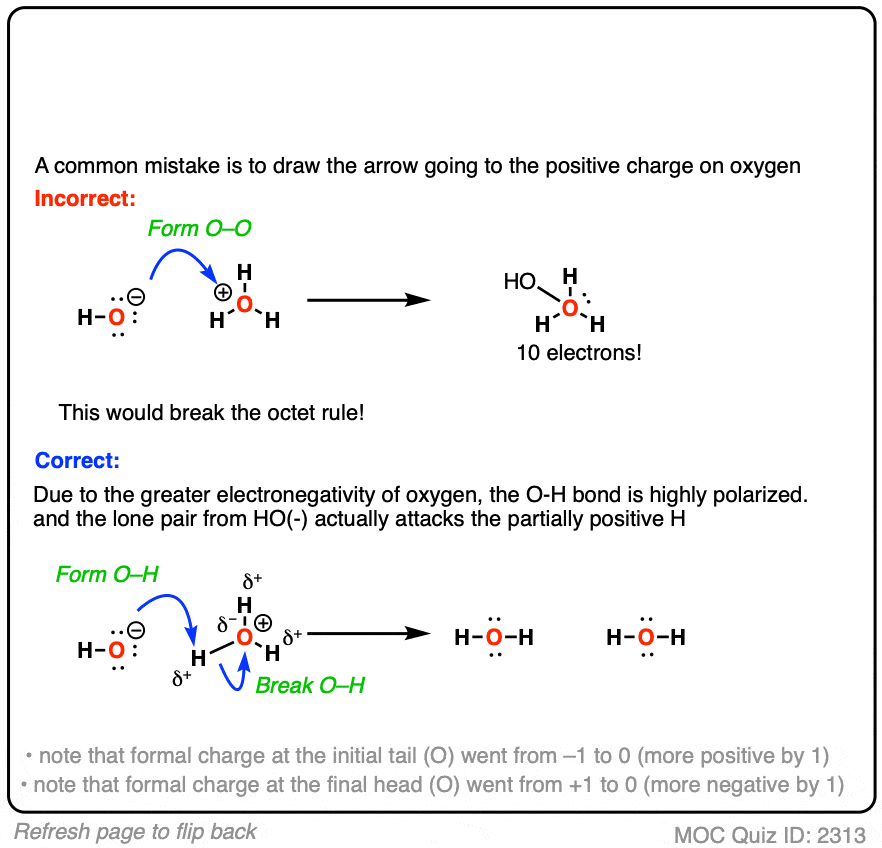
If you did it successfully – congratulations!
But I’m willing to bet that at least a small percentage of you drew the arrow going to the positively charged oxygen.
What’s wrong with that?
There isn’t an empty orbital on oxygen that can accept the lone pair. If you follow the logic of curved arrows, that would result in a new O–O bond, and 10 electrons on the oxygen, breaking the octet rule.
Hold on a minute, you might say. “I thought oxygen was positively charged? If it doesn’t react on oxygen, where is it supposed to react?”
On the hydrogens! H3O+ is Brønsted acid, after all. Right?
This is a great illustration of the reason why it’s called “formal charge”, and how formal charge not the same as electrostatic charge (a.ka. “partial charges” or “electron density”).
Formal charge is ultimately a book-keeping formalism, a little bit like assigning the “win” to one of the 5 pitchers in a baseball game. [Note 3] It doesn’t take into account the fact that the electrons in the oxygen-hydrogen bond are unequally shared, with a substantial dipole.
So although we draw a “formal” charge on oxygen, the partial positive charges are all on hydrogen. Despite bearing a positive formal charge bears a partially negative electrostatic charge.
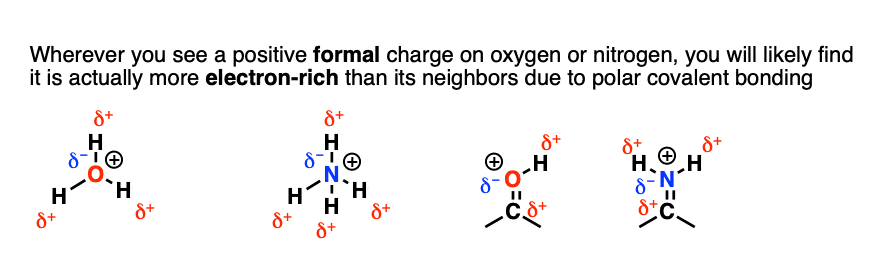
This is why bases such as HO(-) react at the H, not the oxygen.
Just to reiterate:
- Positive charges on oxygen and nitrogen do not represent an empty orbital. Assume that oxygen and nitrogen have full octets! [Note 2]
- In contrast, positive charges on carbon do represent empty orbitals.
6. Halogens
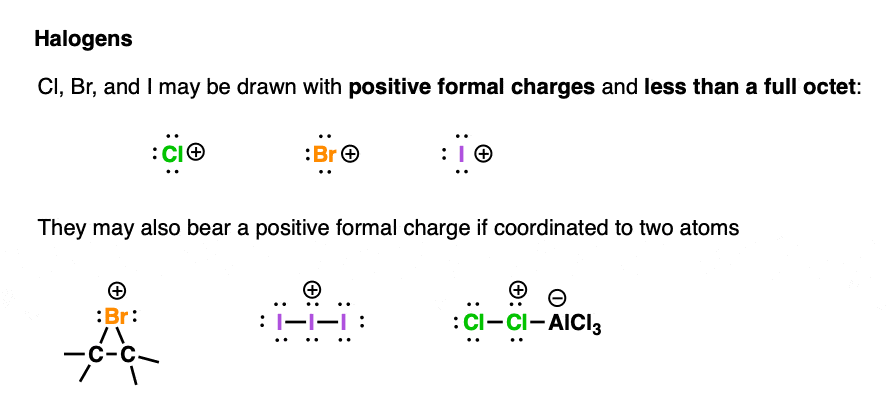
Positive formal charges on halogens fall into two main categories.
We’ll often be found drawing halonium ions Cl+ , Br+, and I+ as species with six valence electrons and an empty orbital (but never F+ – it’s a ravenous beast)
It’s OK to think of these species as bearing an empty orbital since they are large and relatively polarizable. They can distribute the positive charge over their relatively large volume.
These species can accept a lone pair of electrons from a Lewis base, resulting in a full octet.
Cl, Br, and I can also bear positive formal charges as a result of being bonded to two atoms.
It’s important to realize in these cases that the halogen bears a full octet and not an empty orbital. They will therefore not directly accept a pair of electrons from Lewis bases; it’s often the case that the atom adjacent to the halogen accepts the electrons.
7. Conclusion
If you have reached the end and did all the quizzes, you should be well prepared for all the examples of formal charge you see in the rest of the course.
- Formal charge can be calculated using the formula FC = VE – NBE – B
- Line drawings often omit lone pairs and C-H bonds. Be alert for these situations when calculating formal charges.
- Positively charged carbon has an empty orbital, but assume that positively charged nitrogen and oxygen have full octets.
- The example of the hydronium ion H3O+ shows the perils of relying on formal charge to understand reactivity. Pay close attention to the differences in electronegativity between atoms and draw out the dipoles to get a true sense of their reactivity.
Notes
Related Articles
Note 1. Using “valence electrons” gets you the right answer. But if you think about it, it doesn’t quite make sense. Where do positive charges come from? From the positively charged protons in the nucleus, of course!
So the “valence electrons” part of this equation is more properly thought of as a proxy for valence protons – which is another way of saying the “effective nuclear charge”; the charge felt by each valence electron from the nucleus, not counting the filled inner shells.
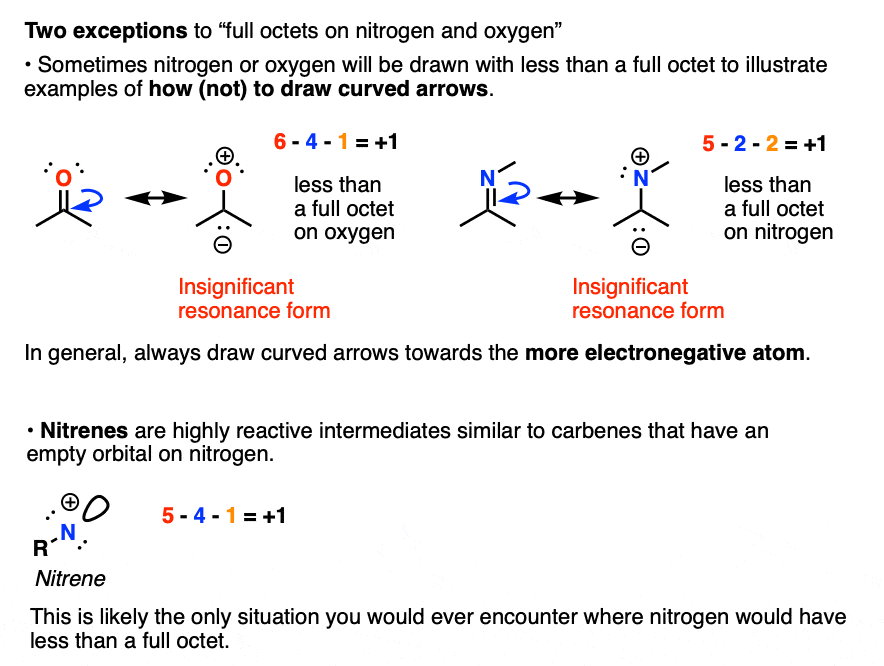
Note 2. Nitrenes are an exception. Another exception is when we want to draw bad resonance forms.
Note 3. In baseball, every game results in a win or a loss for the team. Back in the days of Old Hoss Radborn, where complete games were the norm, a logical extension of this was to assign the win to the individual pitcher. In today’s era, with multiple relief pitchers, there are rules for determining which pitcher gets credited with the win. It’s very possible for a pitcher to get completely shelled on the mound and yet, through fortuitous circumstance, still be credited for the win. See post: Maybe They Should Call Them, “Formal Wins” ?
In the same way, oxygen is given individual credit for the charge of +1 on the hydronium ion, H3O+, even though the actual positive electrostatic charge is distributed among the hydrogens.
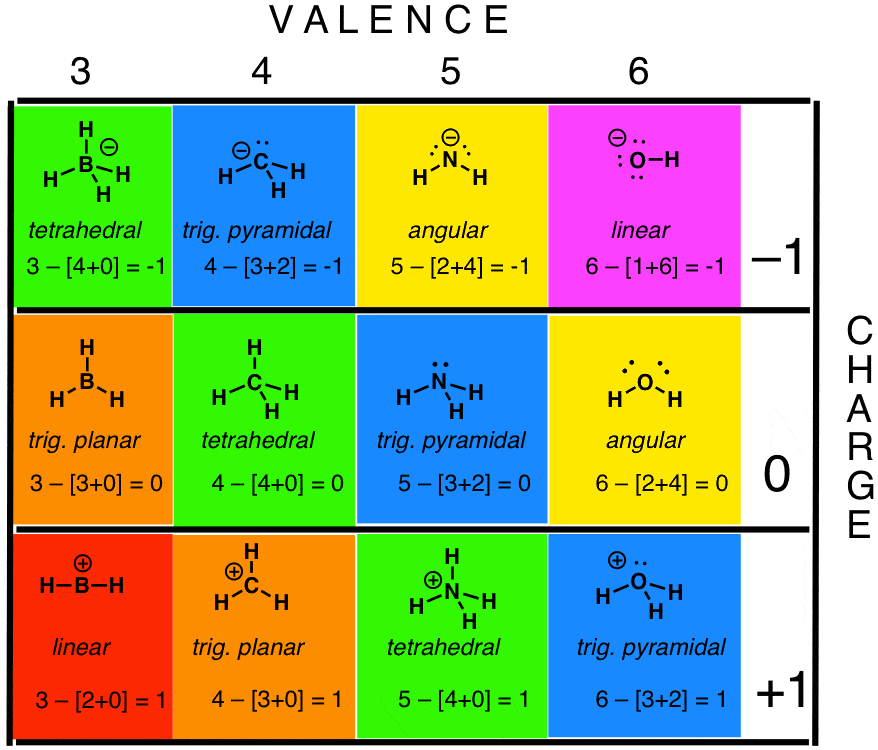
Note 4. This image from a previous incarnation of this post demonstates some relationships for the geometry of various compounds of first-row elements.
Quiz Yourself!
 Click to Flip
Become a MOC member to see the clickable quiz with answers on the back.
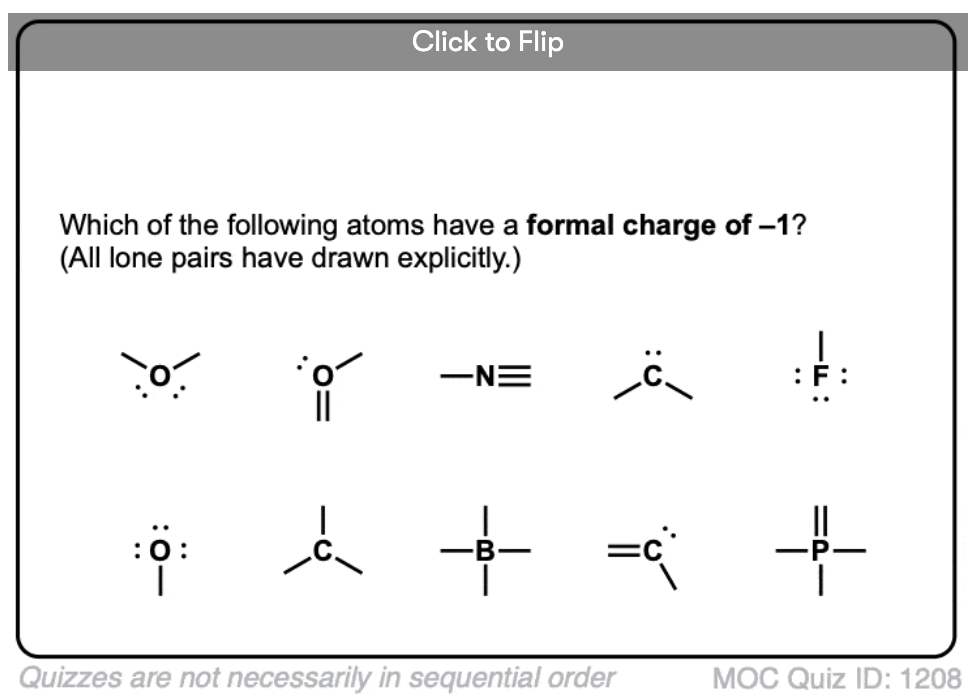
Become a MOC member to see the clickable quiz with answers on the back.
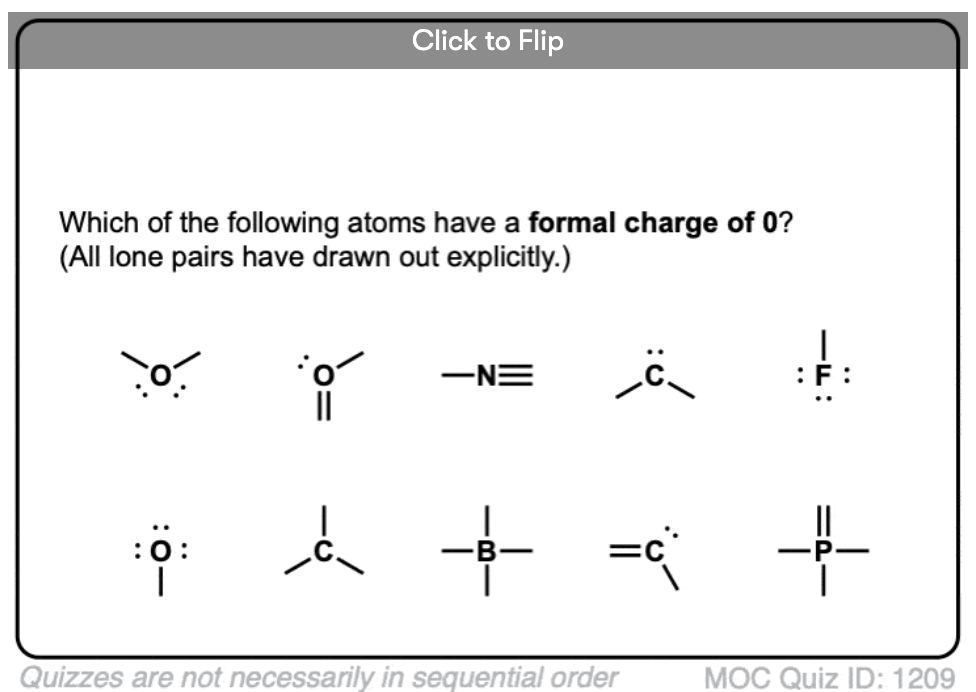
Become a MOC member to see the clickable quiz with answers on the back.
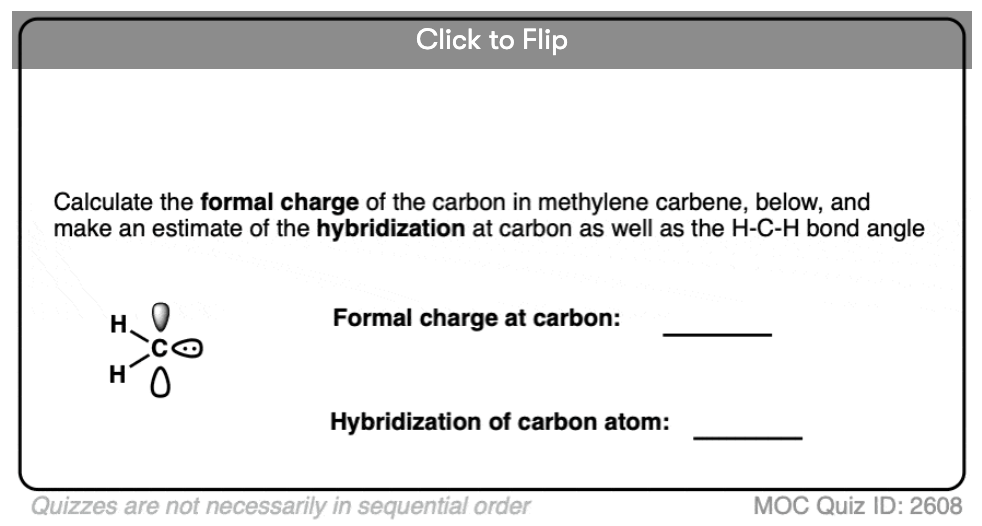
Become a MOC member to see the clickable quiz with answers on the back.
(Advanced) References and Further Reading
1. Valence, Oxidation Number, and Formal Charge: Three Related but Fundamentally Different Concepts
Gerard Parkin
Journal of Chemical Education 2006 83 (5), 791
DOI: 10.1021/ed083p791
2. Lewis structures, formal charge, and oxidation numbers: A more user-friendly approach
John E. Packer and Sheila D. Woodgate
Journal of Chemical Education 1991 68 (6), 456
DOI: 10.1021/ed068p456
00 General Chemistry Review
01 Bonding, Structure, and Resonance
- How Do We Know Methane (CH4) Is Tetrahedral?
- Hybrid Orbitals and Hybridization
- How To Determine Hybridization: A Shortcut
- Orbital Hybridization And Bond Strengths
- Sigma bonds come in six varieties: Pi bonds come in one
- A Key Skill: How to Calculate Formal Charge
- The Four Intermolecular Forces and How They Affect Boiling Points
- 3 Trends That Affect Boiling Points
- How To Use Electronegativity To Determine Electron Density (and why NOT to trust formal charge)
- Introduction to Resonance
- How To Use Curved Arrows To Interchange Resonance Forms
- Evaluating Resonance Forms (1) - The Rule of Least Charges
- How To Find The Best Resonance Structure By Applying Electronegativity
- Evaluating Resonance Structures With Negative Charges
- Evaluating Resonance Structures With Positive Charge
- Exploring Resonance: Pi-Donation
- Exploring Resonance: Pi-acceptors
- In Summary: Evaluating Resonance Structures
- Drawing Resonance Structures: 3 Common Mistakes To Avoid
- How to apply electronegativity and resonance to understand reactivity
- Bond Hybridization Practice
- Structure and Bonding Practice Quizzes
- Resonance Structures Practice
02 Acid Base Reactions
- Introduction to Acid-Base Reactions
- Acid Base Reactions In Organic Chemistry
- The Stronger The Acid, The Weaker The Conjugate Base
- Walkthrough of Acid-Base Reactions (3) - Acidity Trends
- Five Key Factors That Influence Acidity
- Acid-Base Reactions: Introducing Ka and pKa
- How to Use a pKa Table
- The pKa Table Is Your Friend
- A Handy Rule of Thumb for Acid-Base Reactions
- Acid Base Reactions Are Fast
- pKa Values Span 60 Orders Of Magnitude
- How Protonation and Deprotonation Affect Reactivity
- Acid Base Practice Problems
03 Alkanes and Nomenclature
- Meet the (Most Important) Functional Groups
- Condensed Formulas: Deciphering What the Brackets Mean
- Hidden Hydrogens, Hidden Lone Pairs, Hidden Counterions
- Don't Be Futyl, Learn The Butyls
- Primary, Secondary, Tertiary, Quaternary In Organic Chemistry
- Branching, and Its Affect On Melting and Boiling Points
- The Many, Many Ways of Drawing Butane
- Wedge And Dash Convention For Tetrahedral Carbon
- Common Mistakes in Organic Chemistry: Pentavalent Carbon
- Table of Functional Group Priorities for Nomenclature
- Summary Sheet - Alkane Nomenclature
- Organic Chemistry IUPAC Nomenclature Demystified With A Simple Puzzle Piece Approach
- Boiling Point Quizzes
- Organic Chemistry Nomenclature Quizzes
04 Conformations and Cycloalkanes
- Staggered vs Eclipsed Conformations of Ethane
- Conformational Isomers of Propane
- Newman Projection of Butane (and Gauche Conformation)
- Introduction to Cycloalkanes
- Geometric Isomers In Small Rings: Cis And Trans Cycloalkanes
- Calculation of Ring Strain In Cycloalkanes
- Cycloalkanes - Ring Strain In Cyclopropane And Cyclobutane
- Cyclohexane Conformations
- Cyclohexane Chair Conformation: An Aerial Tour
- How To Draw The Cyclohexane Chair Conformation
- The Cyclohexane Chair Flip
- The Cyclohexane Chair Flip - Energy Diagram
- Substituted Cyclohexanes - Axial vs Equatorial
- Ranking The Bulkiness Of Substituents On Cyclohexanes: "A-Values"
- Cyclohexane Chair Conformation Stability: Which One Is Lower Energy?
- Fused Rings - Cis-Decalin and Trans-Decalin
- Naming Bicyclic Compounds - Fused, Bridged, and Spiro
- Bredt's Rule (And Summary of Cycloalkanes)
- Newman Projection Practice
- Cycloalkanes Practice Problems
05 A Primer On Organic Reactions
- The Most Important Question To Ask When Learning a New Reaction
- Curved Arrows (for reactions)
- Nucleophiles and Electrophiles
- The Three Classes of Nucleophiles
- Nucleophilicity vs. Basicity
- What Makes A Good Nucleophile?
- What Makes A Good Leaving Group?
- 3 Factors That Stabilize Carbocations
- Equilibrium and Energy Relationships
- 7 Factors that stabilize negative charge in organic chemistry
- 7 Factors That Stabilize Positive Charge in Organic Chemistry
- What's a Transition State?
- Hammond's Postulate
- Learning Organic Chemistry Reactions: A Checklist (PDF)
- Introduction to Oxidative Cleavage Reactions
06 Free Radical Reactions
- Free Radical Reactions
- 3 Factors That Stabilize Free Radicals
- Bond Strengths And Radical Stability
- Free Radical Initiation: Why Is "Light" Or "Heat" Required?
- Initiation, Propagation, Termination
- Monochlorination Products Of Propane, Pentane, And Other Alkanes
- Selectivity In Free Radical Reactions
- Selectivity in Free Radical Reactions: Bromination vs. Chlorination
- Halogenation At Tiffany's
- Allylic Bromination
- Bonus Topic: Allylic Rearrangements
- In Summary: Free Radicals
- Synthesis (2) - Reactions of Alkanes
- Free Radicals Practice Quizzes
07 Stereochemistry and Chirality
- Types of Isomers: Constitutional Isomers, Stereoisomers, Enantiomers, and Diastereomers
- How To Draw The Enantiomer Of A Chiral Molecule
- How To Draw A Bond Rotation
- Introduction to Assigning (R) and (S): The Cahn-Ingold-Prelog Rules
- Assigning Cahn-Ingold-Prelog (CIP) Priorities (2) - The Method of Dots
- Enantiomers vs Diastereomers vs The Same? Two Methods For Solving Problems
- Assigning R/S To Newman Projections (And Converting Newman To Line Diagrams)
- How To Determine R and S Configurations On A Fischer Projection
- The Meso Trap
- Optical Rotation, Optical Activity, and Specific Rotation
- Optical Purity and Enantiomeric Excess
- What's a Racemic Mixture?
- Chiral Allenes And Chiral Axes
- Stereochemistry Practice Problems and Quizzes
08 Substitution Reactions
- Nucleophilic Substitution Reactions - Introduction
- Two Types of Nucleophilic Substitution Reactions
- The SN2 Mechanism
- Why the SN2 Reaction Is Powerful
- The SN1 Mechanism
- The Conjugate Acid Is A Better Leaving Group
- Comparing the SN1 and SN2 Reactions
- Polar Protic? Polar Aprotic? Nonpolar? All About Solvents
- Steric Hindrance is Like a Fat Goalie
- Common Blind Spot: Intramolecular Reactions
- Substitution Practice - SN1
- Substitution Practice - SN2
09 Elimination Reactions
- Elimination Reactions (1): Introduction And The Key Pattern
- Elimination Reactions (2): The Zaitsev Rule
- Elimination Reactions Are Favored By Heat
- Two Elimination Reaction Patterns
- The E1 Reaction
- The E2 Mechanism
- E1 vs E2: Comparing the E1 and E2 Reactions
- Antiperiplanar Relationships: The E2 Reaction and Cyclohexane Rings
- Bulky Bases in Elimination Reactions
- Comparing the E1 vs SN1 Reactions
- Elimination (E1) Reactions With Rearrangements
- E1cB - Elimination (Unimolecular) Conjugate Base
- Elimination (E1) Practice Problems And Solutions
- Elimination (E2) Practice Problems and Solutions
10 Rearrangements
11 SN1/SN2/E1/E2 Decision
- Identifying Where Substitution and Elimination Reactions Happen
- Deciding SN1/SN2/E1/E2 (1) - The Substrate
- Deciding SN1/SN2/E1/E2 (2) - The Nucleophile/Base
- SN1 vs E1 and SN2 vs E2 : The Temperature
- Deciding SN1/SN2/E1/E2 - The Solvent
- Wrapup: The Key Factors For Determining SN1/SN2/E1/E2
- Alkyl Halide Reaction Map And Summary
- SN1 SN2 E1 E2 Practice Problems
12 Alkene Reactions
- E and Z Notation For Alkenes (+ Cis/Trans)
- Alkene Stability
- Alkene Addition Reactions: "Regioselectivity" and "Stereoselectivity" (Syn/Anti)
- Stereoselective and Stereospecific Reactions
- Hydrohalogenation of Alkenes and Markovnikov's Rule
- Hydration of Alkenes With Aqueous Acid
- Rearrangements in Alkene Addition Reactions
- Halogenation of Alkenes and Halohydrin Formation
- Oxymercuration Demercuration of Alkenes
- Hydroboration Oxidation of Alkenes
- m-CPBA (meta-chloroperoxybenzoic acid)
- OsO4 (Osmium Tetroxide) for Dihydroxylation of Alkenes
- Palladium on Carbon (Pd/C) for Catalytic Hydrogenation of Alkenes
- Cyclopropanation of Alkenes
- A Fourth Alkene Addition Pattern - Free Radical Addition
- Alkene Reactions: Ozonolysis
- Summary: Three Key Families Of Alkene Reaction Mechanisms
- Synthesis (4) - Alkene Reaction Map, Including Alkyl Halide Reactions
- Alkene Reactions Practice Problems
13 Alkyne Reactions
- Acetylides from Alkynes, And Substitution Reactions of Acetylides
- Partial Reduction of Alkynes With Lindlar's Catalyst
- Partial Reduction of Alkynes With Na/NH3 To Obtain Trans Alkenes
- Alkyne Hydroboration With "R2BH"
- Hydration and Oxymercuration of Alkynes
- Hydrohalogenation of Alkynes
- Alkyne Halogenation: Bromination and Chlorination of Alkynes
- Oxidation of Alkynes With O3 and KMnO4
- Alkenes To Alkynes Via Halogenation And Elimination Reactions
- Alkynes Are A Blank Canvas
- Synthesis (5) - Reactions of Alkynes
- Alkyne Reactions Practice Problems With Answers
14 Alcohols, Epoxides and Ethers
- Alcohols - Nomenclature and Properties
- Alcohols Can Act As Acids Or Bases (And Why It Matters)
- Alcohols - Acidity and Basicity
- The Williamson Ether Synthesis
- Ethers From Alkenes, Tertiary Alkyl Halides and Alkoxymercuration
- Alcohols To Ethers via Acid Catalysis
- Cleavage Of Ethers With Acid
- Epoxides - The Outlier Of The Ether Family
- Opening of Epoxides With Acid
- Epoxide Ring Opening With Base
- Making Alkyl Halides From Alcohols
- Tosylates And Mesylates
- PBr3 and SOCl2
- Elimination Reactions of Alcohols
- Elimination of Alcohols To Alkenes With POCl3
- Alcohol Oxidation: "Strong" and "Weak" Oxidants
- Demystifying The Mechanisms of Alcohol Oxidations
- Protecting Groups For Alcohols
- Thiols And Thioethers
- Calculating the oxidation state of a carbon
- Oxidation and Reduction in Organic Chemistry
- Oxidation Ladders
- SOCl2 Mechanism For Alcohols To Alkyl Halides: SN2 versus SNi
- Alcohol Reactions Roadmap (PDF)
- Alcohol Reaction Practice Problems
- Epoxide Reaction Quizzes
- Oxidation and Reduction Practice Quizzes
15 Organometallics
- What's An Organometallic?
- Formation of Grignard and Organolithium Reagents
- Organometallics Are Strong Bases
- Reactions of Grignard Reagents
- Protecting Groups In Grignard Reactions
- Synthesis Problems Involving Grignard Reagents
- Grignard Reactions And Synthesis (2)
- Organocuprates (Gilman Reagents): How They're Made
- Gilman Reagents (Organocuprates): What They're Used For
- The Heck, Suzuki, and Olefin Metathesis Reactions (And Why They Don't Belong In Most Introductory Organic Chemistry Courses)
- Reaction Map: Reactions of Organometallics
- Grignard Practice Problems
16 Spectroscopy
- Degrees of Unsaturation (or IHD, Index of Hydrogen Deficiency)
- Conjugation And Color (+ How Bleach Works)
- Introduction To UV-Vis Spectroscopy
- UV-Vis Spectroscopy: Absorbance of Carbonyls
- UV-Vis Spectroscopy: Practice Questions
- Bond Vibrations, Infrared Spectroscopy, and the "Ball and Spring" Model
- Infrared Spectroscopy: A Quick Primer On Interpreting Spectra
- IR Spectroscopy: 4 Practice Problems
- 1H NMR: How Many Signals?
- Homotopic, Enantiotopic, Diastereotopic
- Diastereotopic Protons in 1H NMR Spectroscopy: Examples
- 13-C NMR - How Many Signals
- Liquid Gold: Pheromones In Doe Urine
- Natural Product Isolation (1) - Extraction
- Natural Product Isolation (2) - Purification Techniques, An Overview
- Structure Determination Case Study: Deer Tarsal Gland Pheromone
17 Dienes and MO Theory
- What To Expect In Organic Chemistry 2
- Are these molecules conjugated?
- Conjugation And Resonance In Organic Chemistry
- Bonding And Antibonding Pi Orbitals
- Molecular Orbitals of The Allyl Cation, Allyl Radical, and Allyl Anion
- Pi Molecular Orbitals of Butadiene
- Reactions of Dienes: 1,2 and 1,4 Addition
- Thermodynamic and Kinetic Products
- More On 1,2 and 1,4 Additions To Dienes
- s-cis and s-trans
- The Diels-Alder Reaction
- Cyclic Dienes and Dienophiles in the Diels-Alder Reaction
- Stereochemistry of the Diels-Alder Reaction
- Exo vs Endo Products In The Diels Alder: How To Tell Them Apart
- HOMO and LUMO In the Diels Alder Reaction
- Why Are Endo vs Exo Products Favored in the Diels-Alder Reaction?
- Diels-Alder Reaction: Kinetic and Thermodynamic Control
- The Retro Diels-Alder Reaction
- The Intramolecular Diels Alder Reaction
- Regiochemistry In The Diels-Alder Reaction
- The Cope and Claisen Rearrangements
- Electrocyclic Reactions
- Electrocyclic Ring Opening And Closure (2) - Six (or Eight) Pi Electrons
- Diels Alder Practice Problems
- Molecular Orbital Theory Practice
18 Aromaticity
- Introduction To Aromaticity
- Rules For Aromaticity
- Huckel's Rule: What Does 4n+2 Mean?
- Aromatic, Non-Aromatic, or Antiaromatic? Some Practice Problems
- Antiaromatic Compounds and Antiaromaticity
- The Pi Molecular Orbitals of Benzene
- The Pi Molecular Orbitals of Cyclobutadiene
- Frost Circles
- Aromaticity Practice Quizzes
19 Reactions of Aromatic Molecules
- Electrophilic Aromatic Substitution: Introduction
- Activating and Deactivating Groups In Electrophilic Aromatic Substitution
- Electrophilic Aromatic Substitution - The Mechanism
- Ortho-, Para- and Meta- Directors in Electrophilic Aromatic Substitution
- Understanding Ortho, Para, and Meta Directors
- Why are halogens ortho- para- directors?
- Disubstituted Benzenes: The Strongest Electron-Donor "Wins"
- Electrophilic Aromatic Substitutions (1) - Halogenation of Benzene
- Electrophilic Aromatic Substitutions (2) - Nitration and Sulfonation
- EAS Reactions (3) - Friedel-Crafts Acylation and Friedel-Crafts Alkylation
- Intramolecular Friedel-Crafts Reactions
- Nucleophilic Aromatic Substitution (NAS)
- Nucleophilic Aromatic Substitution (2) - The Benzyne Mechanism
- Reactions on the "Benzylic" Carbon: Bromination And Oxidation
- The Wolff-Kishner, Clemmensen, And Other Carbonyl Reductions
- More Reactions on the Aromatic Sidechain: Reduction of Nitro Groups and the Baeyer Villiger
- Aromatic Synthesis (1) - "Order Of Operations"
- Synthesis of Benzene Derivatives (2) - Polarity Reversal
- Aromatic Synthesis (3) - Sulfonyl Blocking Groups
- Birch Reduction
- Synthesis (7): Reaction Map of Benzene and Related Aromatic Compounds
- Aromatic Reactions and Synthesis Practice
- Electrophilic Aromatic Substitution Practice Problems
20 Aldehydes and Ketones
- What's The Alpha Carbon In Carbonyl Compounds?
- Nucleophilic Addition To Carbonyls
- Aldehydes and Ketones: 14 Reactions With The Same Mechanism
- Sodium Borohydride (NaBH4) Reduction of Aldehydes and Ketones
- Grignard Reagents For Addition To Aldehydes and Ketones
- Wittig Reaction
- Hydrates, Hemiacetals, and Acetals
- Imines - Properties, Formation, Reactions, and Mechanisms
- All About Enamines
- Breaking Down Carbonyl Reaction Mechanisms: Reactions of Anionic Nucleophiles (Part 2)
- Aldehydes Ketones Reaction Practice
21 Carboxylic Acid Derivatives
- Nucleophilic Acyl Substitution (With Negatively Charged Nucleophiles)
- Addition-Elimination Mechanisms With Neutral Nucleophiles (Including Acid Catalysis)
- Basic Hydrolysis of Esters - Saponification
- Transesterification
- Proton Transfer
- Fischer Esterification - Carboxylic Acid to Ester Under Acidic Conditions
- Lithium Aluminum Hydride (LiAlH4) For Reduction of Carboxylic Acid Derivatives
- LiAlH[Ot-Bu]3 For The Reduction of Acid Halides To Aldehydes
- Di-isobutyl Aluminum Hydride (DIBAL) For The Partial Reduction of Esters and Nitriles
- Amide Hydrolysis
- Thionyl Chloride (SOCl2) And Conversion of Carboxylic Acids to Acid Halides
- Diazomethane (CH2N2)
- Carbonyl Chemistry: Learn Six Mechanisms For the Price Of One
- Making Music With Mechanisms (PADPED)
- Carboxylic Acid Derivatives Practice Questions
22 Enols and Enolates
- Keto-Enol Tautomerism
- Enolates - Formation, Stability, and Simple Reactions
- Kinetic Versus Thermodynamic Enolates
- Aldol Addition and Condensation Reactions
- Reactions of Enols - Acid-Catalyzed Aldol, Halogenation, and Mannich Reactions
- Claisen Condensation and Dieckmann Condensation
- Decarboxylation
- The Malonic Ester and Acetoacetic Ester Synthesis
- The Michael Addition Reaction and Conjugate Addition
- The Robinson Annulation
- Haloform Reaction
- The Hell–Volhard–Zelinsky Reaction
- Enols and Enolates Practice Quizzes
23 Amines
- The Amide Functional Group: Properties, Synthesis, and Nomenclature
- Basicity of Amines And pKaH
- 5 Key Basicity Trends of Amines
- The Mesomeric Effect And Aromatic Amines
- Nucleophilicity of Amines
- Alkylation of Amines (Sucks!)
- Reductive Amination
- The Gabriel Synthesis
- Some Reactions of Azides
- The Hofmann Elimination
- The Hofmann and Curtius Rearrangements
- The Cope Elimination
- Protecting Groups for Amines - Carbamates
- The Strecker Synthesis of Amino Acids
- Introduction to Peptide Synthesis
- Reactions of Diazonium Salts: Sandmeyer and Related Reactions
- Amine Practice Questions
24 Carbohydrates
- D and L Notation For Sugars
- Pyranoses and Furanoses: Ring-Chain Tautomerism In Sugars
- What is Mutarotation?
- Reducing Sugars
- The Big Damn Post Of Carbohydrate-Related Chemistry Definitions
- The Haworth Projection
- Converting a Fischer Projection To A Haworth (And Vice Versa)
- Reactions of Sugars: Glycosylation and Protection
- The Ruff Degradation and Kiliani-Fischer Synthesis
- Isoelectric Points of Amino Acids (and How To Calculate Them)
- Carbohydrates Practice
- Amino Acid Quizzes
25 Fun and Miscellaneous
- A Gallery of Some Interesting Molecules From Nature
- Screw Organic Chemistry, I'm Just Going To Write About Cats
- On Cats, Part 1: Conformations and Configurations
- On Cats, Part 2: Cat Line Diagrams
- On Cats, Part 4: Enantiocats
- On Cats, Part 6: Stereocenters
- Organic Chemistry Is Shit
- The Organic Chemistry Behind "The Pill"
- Maybe they should call them, "Formal Wins" ?
- Why Do Organic Chemists Use Kilocalories?
- The Principle of Least Effort
- Organic Chemistry GIFS - Resonance Forms
- Reproducibility In Organic Chemistry
- What Holds The Nucleus Together?
- How Reactions Are Like Music
- Organic Chemistry and the New MCAT
26 Organic Chemistry Tips and Tricks
- Common Mistakes: Formal Charges Can Mislead
- Partial Charges Give Clues About Electron Flow
- Draw The Ugly Version First
- Organic Chemistry Study Tips: Learn the Trends
- The 8 Types of Arrows In Organic Chemistry, Explained
- Top 10 Skills To Master Before An Organic Chemistry 2 Final
- Common Mistakes with Carbonyls: Carboxylic Acids... Are Acids!
- Planning Organic Synthesis With "Reaction Maps"
- Alkene Addition Pattern #1: The "Carbocation Pathway"
- Alkene Addition Pattern #2: The "Three-Membered Ring" Pathway
- Alkene Addition Pattern #3: The "Concerted" Pathway
- Number Your Carbons!
- The 4 Major Classes of Reactions in Org 1
- How (and why) electrons flow
- Grossman's Rule
- Three Exam Tips
- A 3-Step Method For Thinking Through Synthesis Problems
- Putting It Together
- Putting Diels-Alder Products in Perspective
- The Ups and Downs of Cyclohexanes
- The Most Annoying Exceptions in Org 1 (Part 1)
- The Most Annoying Exceptions in Org 1 (Part 2)
- The Marriage May Be Bad, But the Divorce Still Costs Money
- 9 Nomenclature Conventions To Know
- Nucleophile attacks Electrophile
27 Case Studies of Successful O-Chem Students
- Success Stories: How Corina Got The The "Hard" Professor - And Got An A+ Anyway
- How Helena Aced Organic Chemistry
- From a "Drop" To B+ in Org 2 – How A Hard Working Student Turned It Around
- How Serge Aced Organic Chemistry
- Success Stories: How Zach Aced Organic Chemistry 1
- Success Stories: How Kari Went From C– to B+
- How Esther Bounced Back From a "C" To Get A's In Organic Chemistry 1 And 2
- How Tyrell Got The Highest Grade In Her Organic Chemistry Course
- This Is Why Students Use Flashcards
- Success Stories: How Stu Aced Organic Chemistry
- How John Pulled Up His Organic Chemistry Exam Grades
- Success Stories: How Nathan Aced Organic Chemistry (Without It Taking Over His Life)
- How Chris Aced Org 1 and Org 2
- Interview: How Jay Got an A+ In Organic Chemistry
- How to Do Well in Organic Chemistry: One Student's Advice
- "America's Top TA" Shares His Secrets For Teaching O-Chem
- "Organic Chemistry Is Like..." - A Few Metaphors
- How To Do Well In Organic Chemistry: Advice From A Tutor
- Guest post: "I went from being afraid of tests to actually looking forward to them".
Hello,
thanks for your wonderful posts on organic chemistry. It reallys helps me to recap org chem and I really like how you explain all these topics with a bit of humor.
That said, I think in this posts may be some typos:
I think there are two typos in the solution of the last quiz of chapter 3 (ID 2310):
(a) In the third task [C3H7N] of the quiz, there is just one electron on the negative charged carbon. Shouldn’t there be two electrons?
(b) And in the fourth task [O-CH2] the sign of the formal charge of the carbon atom should be +1 (in the calculation).
(c) Note 4 says “(…) of various compounds of first-row elements.” Aren’t the shown elements in the picture from the second row of the periodic table?
Thank you very much!
Your explanations and examples were clear and easy to understand. I appreciate the detailed step-by-step instructions, which made it easy to follow along and understand the concept. Thank you for taking the time to create this helpful resource
I think for Quiz ID: 2310, the formal charge for the carbon in the fourth molecule should be +1 instead of -1.
Fixed. Thanks for the spot!
Thank you so much sir. Finally i understood how to calculate the formal charge
Nice simple explanation
Great teaching , can I know where did u studied ??
Hi I am extremely confused. The two formulas for calculating FC that you provided are not the same and don’t produce the same results when I tried them out.
Formal charge = [# of valence electrons] – [electrons in lone pairs + 1/2 the number of bonding electrons]
and
Formal Charge = [# of valence electrons on atom] – [non-bonded electrons + number of bonds].
They do not produce the same result…
If I have the formula BH4, and use the first formula provided to find FC of B, I would get:
(3) – (0 + 2) = +1
Using the second formula provided:
(3) – (0+4) = -1
Aren’t these formulas supposed to produce the same results? I am quite confused and I don’t know if I missed something.
Ah. I should have been more clear. The number of bonding electrons in BH4 equals 8, since each bond has two electrons and there are 4 B-H bonds. Half of this number equals 4. This should give you the same answer.
I have updated the post to make this more explicit.
That was the best i have seen but i have a problem with the formula,i think the side where the shared pair electrons came was suppose to be negative but then yours was positive,so am finfding it difficult to understand because the slides we were given by our lecturer shows that it was subtracted not added. i would love it when u explain it to me.
It was a very great explanation! Now I have a good concept about how to find formula charge.
And also i am just a grade nine student so i want to say thank you for this.
YOU ARE THE BEST. I GOT THE HIGHEST MARK IN MY FIRST QUIZ, AND I KNOW THAT THROUGH THIS I WILL GET THE BEST IN MIDTERM AND FINAL. I want you guys to go on youtube and follow the steps. THANK YOU VERY MUCH.
I remember learning that in the cyanide ion, the carbon is nucleophilic because the formal negative charge is on carbon, not nitrogen, despite nitrogen being more electronegative. So I think a different explanation could me more accurate, but I’m not sure how to properly address it. I better keep reading.
In cyanide ion, there are two lone pairs – one on carbon, one on nitrogen. The lone pair on carbon is more nucleophilic because it is less tightly held (the atom is less electronegative than nitrogen).
On all the examples I show that are negatively charged (eg BH4(-) ) there isn’t a lone pair to complicate questions of nucleophilicity.
This really helped for neutral covalent molecules. However, I’m having trouble applying this technique for molecules with an overall charge other than 0. For instance, in (ClO2)- , the formal charge of Cl should be 1. However, with your equation the charge should be 0. With the conventional equation, the charge is indeed 1.
I’d appreciate it if you replied sooner rather than later, as I do have a chemistry midterm on Friday. I’m quite confused with formal charges :)
Thanks for the study guide.
This method is wrong
For CH3 , the valence eloctron is 4 , no : of bonds is 3 and no of non bonded electrons is 1
Then by this equation
F.C= 4-(1+3) = 0 but here it is given as +1
That analysis would be accurate for the methyl radical. However it fails for the methyl carbocation.
That example referred to the carbocation. For the methyl radical, the formal charge is indeed zero.
This was so helpful n the best explanation about the topic…
Thanks for the easy approach.
But when I used this formula it works. Thus
#valence electrons_#lone pair__#1/2.bond pairs
Thanks for the easy approach.
I have a problem in finding the FC on each O atom in ozone. Can you help me with that ASAP?
The FC on central atom would be +1 because [6-(2+3)]
FC on O atom with coordinate bond would be: -1 because [6-(6+1)].
FC on O atom with double bond is: 0 because [6-(4+2)].
Hope I solved your question!
Thank u very much my exam is today and i wouldn’t pass without this information
AM REALLY LOST NOW
ON THAT EXAMPLE OF CH3
CARBON
# OF VALENCE ELECTRON=4
# OF BONDING=3
# OF UNSHARED=1
SO WHEN I CALCULATE
FORMAL CHARGE=(#OF VALENCE ELEC)+[(1/2#OF BOND)+(#OF UNSHARED)]
FORMAL CHARGE=4+[(1/2*3)+1]
=1.5
PLZ HELP IF AM MAKING MISTAKE
Should be 1/2 [# of bonding ELECTRONS] + # unshared.
This gives you 4 – [3 – 1]
= 0 for ch3 radical.
Should be for CH3(+), not the methyl radical •CH3 .
I am beryllium and i got offended!!!!!!……..LOL Just kidding…….BTW, I found this article very useful.Thanks!!!!!!!!!!
what does it means if we determine a molecule with zero charge
?
It’s neutral!
you said that non bonded electrons in carbon is 2, but how ?
because i see it as only 1 because out of the 4 valence electrons in carbon, three are paired with hydrogen so it’s only 1 left
If the charge is -1, there must be an “extra” electron on carbon – this is why there’s a lone pair. If there was only one electron, it would be neutral.
This works! I would take your class with organic chemistry if you are a professor. I am taking chemistry 2 now. Organic is next.
Thank you so much!
Thank you very very more for the simple explanation! Unbelievably easy and saves so much time!!!!!!
Thank you!!! this was awesome, I’m a junior in chemistry and this finally answered all my questions about formal charge :)
Glad it was helpful Haley!
If formal charges bear no resemblance to reality, what are their significance?
I hope the post doesn’t get interpreted as “formal charges have no significance”. If it does I will have to change some of the wording.
What I mean to get across is that formal charges assigned to atoms do not *always* accurately depict electron density on that atom, and one has to be careful.
In other words, formal charge and electron density are two different things and they do not always overlap.
Formal charge is a book-keeping device, where we count electrons and assign a full charge to one or more of the atoms on a molecule or ion.
Electron density, on the other hand, is a measurement of where the electrons actually are (or aren’t) on a species, and those charges can be fractional or partial charges.
First of all, the charge itself is very real. The ions NH4+ , HO-, H3O+ and so on actually do bear a single charge. The thing to remember is that from a charge density perspective, that charge might be distributed over multiple atoms.
Take an ion like H3O+, for example. H3O *does* bear a charge of +1,
However, if one thinks about where the electrons are in H3O+, one realizes that oxygen is more electronegative than hydrogen, and is actually “taking’ electrons from each hydrogen. If you look at an electron density map of H3O+ , one will see that the positive charge is distributed on the three hydrogens, and the oxygen actually bears a slight negative charge. There’s a nice map here.
http://chemwiki.ucdavis.edu/Physical_Chemistry/Acids_and_Bases/Aqueous_Solutions/The_hydronium_Ion
When we calculate formal charge for H3O+, we assign a charge of +1 to oxygen. This is for book keeping reasons. As a book-keeping device, it would be a royal pain to deal with fractions of charges like this. So that’s why we calculate formal charge and use it.
Sometimes it does accurately depict electron density. For example, in the hydroxide ion, HO- , the negative charge is almost all on the oxygen.
If you have a firm grasp of electronegativity then it becomes less confusing.
Does that help?
There are meny compounds which bears various structure among these which one is more stable or less energetic is it possible to predicu from the formal charge calculation?
Hey great explanation. I have a question though. Why is the FC commonly +/- 1? Could you give me an example when the FC is not +/- 1? Thanks.
Sure, try oxygen with no bonds and a full octet of electrons.
Great!i can use this for my exam!thanks!
Shouldn’t the formal charge of CH3 be -1? I was just wondering because in your example its +1 and in the chart its -1.
In the question.. its mentioned that CH3 without any lone pairs.. which means the valence would be 4 but there will not be any (2electrons) lone pairs left.. Hence it will be (4-)-(0+3)= 1
Yes.
In CH3 i think FC on C should be -1 as carbon valency is 4 it has already bonded with 3 hydrogen atom one electron is left free on carbon to get bond with or share with one electron H hence, number of non bonded electrons lone pair of electrons is considered as 2. 4-(2+3) = -1.
In your case if we take 0 than valency of c is not satisfied.
thank you for collaboration of formal charge
The answer to the question in the post above is “carbenes” – they have two substitutents, one pair of electrons, and an empty p orbital – so a total of four electrons “to itself”, making it neutral.
thank you for excellent explanation
Glad you found it useful Peter!
Very good explanation.I finally understood how to calculate the formal charge,was having some trouble with it.Thanks:)
Glad you found it helpful.
nice, concise explanation
Thanks.
sir
the sheet posted by u is really very excellent.i m teacher of chemistry in india for pre engineering test.if u send me complete flow chart of chemistry i will great full for u